Free Solver Charts
Facing a Raise: Defense Ranges
Someone opens and it folds to you — do you fold, flat, or 3-bet? These are the GTO defense ranges from the blinds vs every opening position in 6-max cash. Click any cell for the full range.
Generated from our solver database · 6-max cash (NL500) · 100bb · data decoded 28 Jul 2026 · method
| Defender | vs LJ | vs HJ | vs CO | vs BTN | vs SB |
|---|---|---|---|---|---|
| HJ defense | 11% | — | — | — | — |
| CO defense | 12% | 13% | — | — | — |
| BTN defense | 14% | 16% | 19% | — | — |
| SB defense | 11% | 13% | 14% | 18% | — |
| BB defense | 28% | 31% | 37% | 45% | 56% |
Each cell shows the total defend frequency (call + 3-bet). Click for the call/3-bet/fold breakdown and a trainer.
The spots most players need
Full grids for the most common facing-a-raise spots. Every cell in the table above has the same page, a PNG to save, and a trainer.
Big Blind vs Button open
defends 45% · 32% call, 13% 3-bet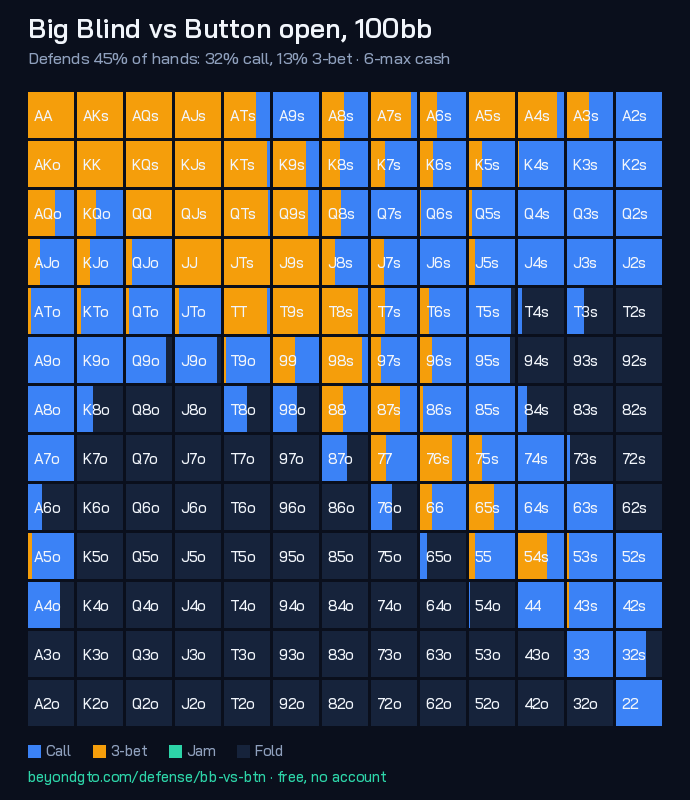
Big Blind vs Small Blind open
defends 56% · 39% call, 17% 3-bet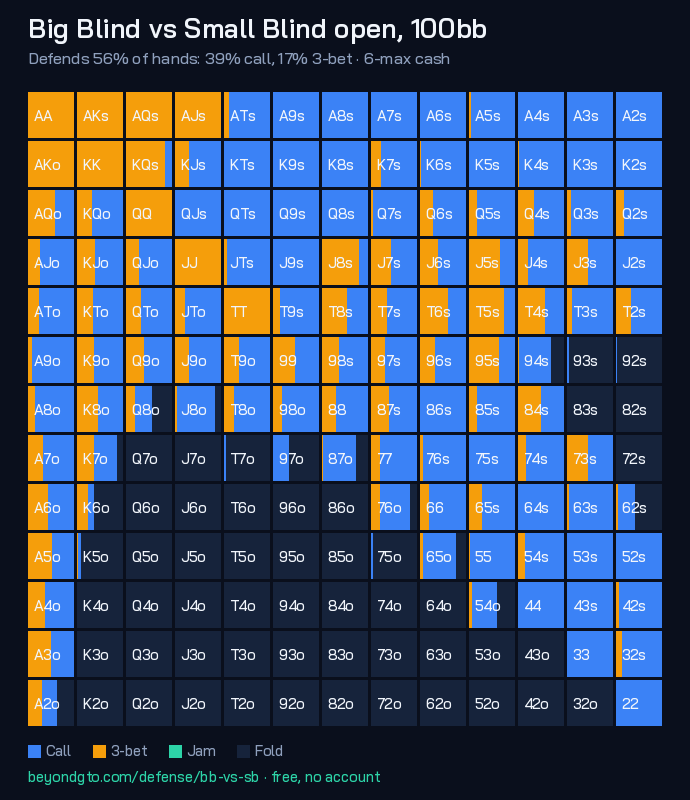
Small Blind vs Button open
defends 18% · 5% call, 13% 3-bet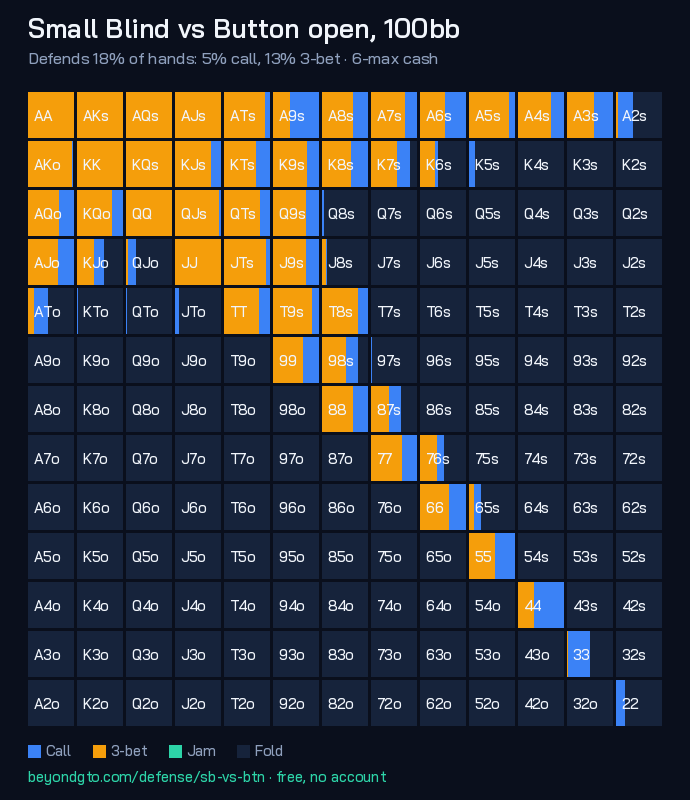
Button vs Cutoff open
defends 19% · 9% call, 10% 3-bet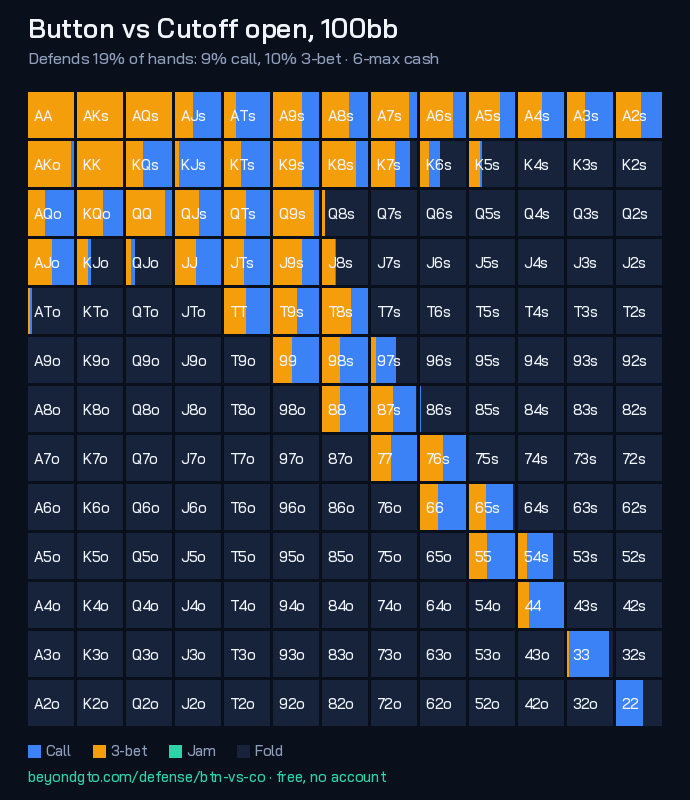
Big Blind vs LoJack open
defends 28% · 21% call, 6% 3-bet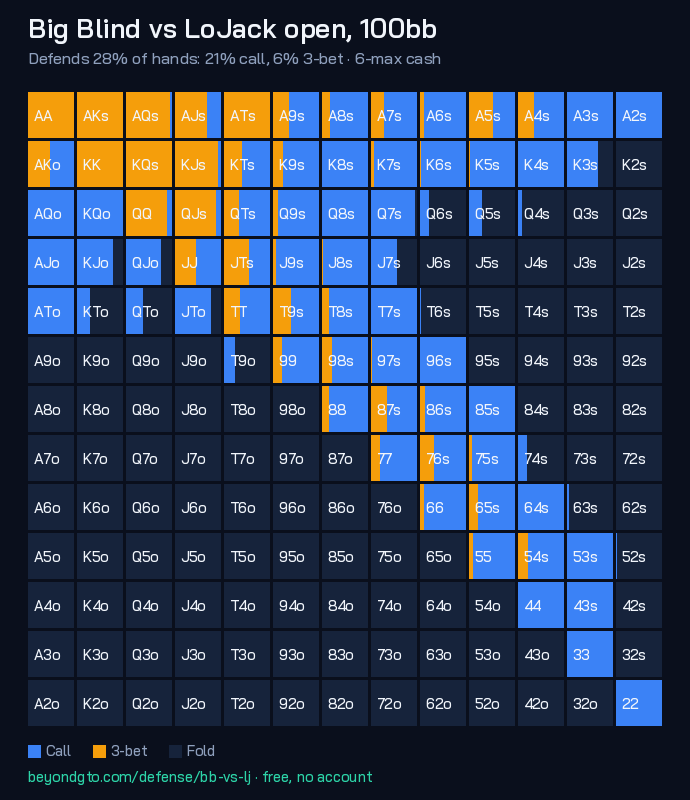
Cutoff vs HiJack open
defends 13% · 5% call, 8% 3-bet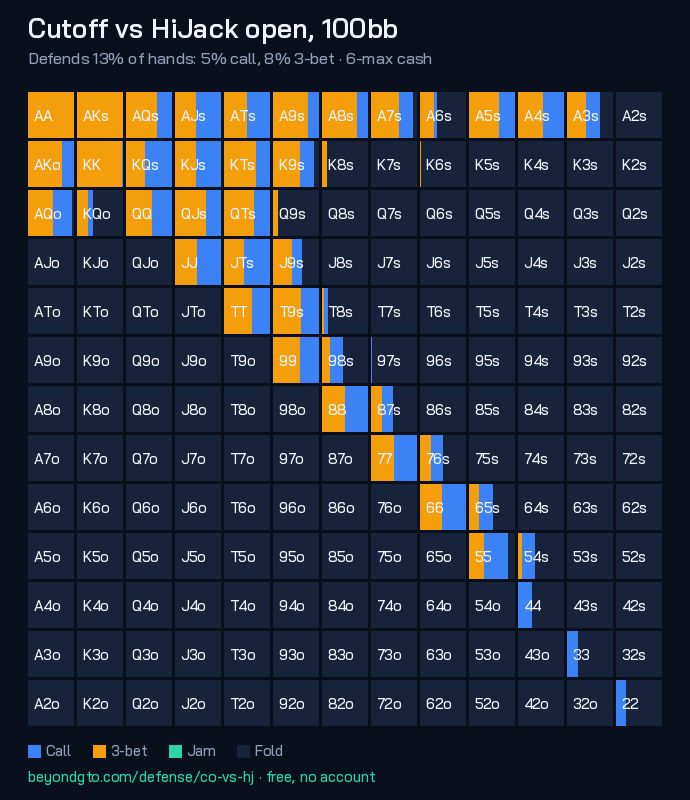
How to read a defense chart
Each chart is the hero's first decision after one player opens and everyone else folds: call (blue), 3-bet (amber), or fold (navy), for all 169 starting hands. A split cell is a mixed strategy. The percentage above each chart is the share of hands that continue by either route.
The opener's seat sets the whole shape. From the big blind against a 2.5bb open, the defending range runs vs LJ 28% (21% call, 6% 3-bet), vs HJ 31% (23% call, 8% 3-bet), vs CO 37% (26% call, 10% 3-bet), vs BTN 45% (32% call, 13% 3-bet). A button opener has the widest, weakest range, so more of the big blind's hands are ahead of it and more bluffs get folds; a lojack opener is strong, so the big blind folds more and 3-bets for value only.
Small blind: 3-bet or fold
Facing the same button open, the small blind 3-bets 13% and calls only 5%, while the big blind 3-bets 13% and calls 32%. The 3-bet frequencies match; the calling ranges are a world apart. The small blind that calls will be out of position for the whole hand with the big blind still to act behind it, inviting a squeeze or a third player. Raising fixes both problems at once, so almost every hand the small blind plays, it plays as a 3-bet. The big blind, closing the action with the best price on the table, can profitably flat a wide range of hands that are too weak to 3-bet and too good to fold.
In position: 3-bet about as often as you call
With position and the blinds still to act, cold-calling an open is a weaker play than it looks: it leaves two players behind who can squeeze, and it caps the hands you can show up with. The solver keeps the in-position calling ranges small and 3-bets with roughly as many hands as it calls: BTN-VS-CO 9% call, 10% 3-bet; CO-VS-HJ 5% call, 8% 3-bet; HJ-VS-LJ 4% call, 6% 3-bet. The 3-bets are polarised, premium pairs and big suited hands at one end, suited aces and suited connectors at the other, with the medium pairs and suited broadways doing most of the calling.
Blind versus blind
When the small blind opens to 3 big blinds and it folds to the big blind, the big blind defends 56% of hands: 39% by calling and 17% by 3-betting, the widest defence on this page. The small blind's opening range is wide, the big blind has position for the rest of the hand, and there is nobody left to act, so even weak offsuit hands have a profitable continue. The 3-bets are the widest too, and many of them are offsuit hands that would be folds against any other opener.
What these charts assume, and when to adjust
- One opener, everyone else folded. Facing an open and a caller is a different spot; the squeeze and the overcall are not on this page.
- Open sizes. 2.5 big blinds from every seat, 3 from the small blind. Against a larger open, defend tighter from the big blind, because the price is worse; against a minimum raise, defend wider.
- 6-max cash at 100 big blinds. Deeper stacks favour calling with hands that play well postflop; shorter stacks favour 3-betting and folding. In tournaments with antes, the big blind defends wider still.
- A correct opener. Against a player who opens far more than the charts say, 3-bet more; against one who opens tight, call less and fold more of the marginal hands.
The full method is on the methodology page. For what happens after you 3-bet, and how often the opener folds, see the 3-bet study.
Common mistakes
- Folding the big blind too much. The big blind is the only seat with a discount, and against a late opener the solver continues with close to half its hands. Folding most of them costs more than any other preflop leak.
- Flatting from the small blind. A small blind that calls with hands it should 3-bet or fold plays the big blind's strategy from the worst seat at the table.
- 3-betting only premiums. Against a button open the big blind 3-bets 13% of hands; aces to queens and ace-king are under 3% of hands. The rest are suited aces, suited connectors and suited broadways.
- Using one range against every opener. The big blind's defence against a lojack and against a button differ by more than fifteen percentage points. The opener's seat is the first thing to check.
Questions
- How often should you defend your big blind?
- It depends on who opened. Against a 2.5bb button open in 6-max cash, the solver defends 45% of hands (32% by calling, 13% by 3-betting). Against a lojack open it defends 28% (21% call, 6% 3-bet).
- Should you call or 3-bet from the small blind?
- Mostly 3-bet. Facing a button open, the small blind 3-bets 13% of hands and calls only 5%, because a call leaves it out of position with the big blind still to act. Hands too weak to 3-bet are usually folds, not calls.
- How wide should the big blind defend against a small blind open?
- Very wide: 56% of hands against a 3bb small-blind open, 39% by calling and 17% by 3-betting. The big blind has position, closes the action and faces a wide opening range.
- How often should the button 3-bet a cutoff open?
- About 10% of hands, against a calling range of 9%. In position with the blinds behind, the solver 3-bets roughly as often as it calls, with a polarised range: big pairs and suited broadways plus suited aces and suited connectors.
- What is a defense range?
- The set of hands that continue when someone opens and the action reaches you with everyone else folded, split into the hands that call and the hands that 3-bet. These charts show that split for every seat against every opener in 6-max cash at 100 big blinds.
- Why does the big blind call so much more than any other seat?
- Because it already has a big blind in the pot, so a call costs 1.5 big blinds to see a pot of 4, and nobody acts after it. Every other seat either has a worse price or players behind who can squeeze, which pushes them towards 3-betting or folding.
- Do these ranges apply to tournaments?
- As a starting point. With a big-blind ante the pot is larger before any raise, so the big blind defends wider than these cash ranges; with shorter stacks, 3-betting and folding take over from calling. The push/fold charts cover the shortest stacks.
- What size open do the charts assume?
- 2.5 big blinds from every seat except the small blind, which opens to 3. Against a bigger raise, defend tighter; against a minimum raise, wider.
More free resources