Free Solver Charts
Opening Ranges
The GTO first-in opening range for every position — 6-max cash, tournament play from 10bb to 100bb, and 3-handed Spin & Go, generated from 118 solver-solved spots.
Generated from our solver database. No fabricated numbers — every frequency is decoded from a solved game tree. · method
Data decoded 27 Aug 2026 · download every chart as a PDF, no email needed
6-Max Cash — 100bb
Tournament (MTT) — Chip EV
| Stack | UTG | MP | LJ | HJ | CO | BTN | SB |
|---|---|---|---|---|---|---|---|
| 10bb | 18% | 20% | 23% | 28% | 33% | 41% | 79% |
| 12bb | 17% | 20% | 23% | 27% | 34% | 41% | 82% |
| 15bb | 16% | 18% | 20% | 24% | 29% | 38% | 83% |
| 17bb | 17% | 19% | 22% | 26% | 34% | 46% | 84% |
| 20bb | 17% | 20% | 22% | 26% | 32% | 42% | 84% |
| 23bb | 18% | 21% | 23% | 27% | 33% | 44% | 84% |
| 25bb | 18% | 21% | 24% | 28% | 34% | 45% | 84% |
| 30bb | 18% | 21% | 24% | 29% | 36% | 48% | 83% |
| 35bb | 18% | 20% | 24% | 29% | 36% | 49% | 83% |
| 40bb | 17% | 20% | 24% | 29% | 37% | 52% | 83% |
| 50bb | 16% | 19% | 23% | 28% | 36% | 53% | 84% |
| 60bb | 16% | 18% | 22% | 27% | 36% | 53% | 86% |
| 100bb | 16% | 19% | 23% | 28% | 36% | 56% | 87% |
Spin & Go — 3-Handed
| Stack | BTN | SB |
|---|---|---|
| 2bb | 43% | 87% |
| 4bb | 42% | 73% |
| 6bb | 39% | 70% |
| 8bb | 35% | 67% |
| 10bb | 35% | 66% |
| 12bb | 34% | 65% |
| 15bb | 33% | 66% |
| 17bb | 33% | 67% |
| 20bb | 34% | 69% |
| 23bb | 37% | 69% |
| 25bb | 38% | 68% |
The ranges most players need
Full grids for the spots that come up most. Every other stack and seat in the tables above has the same page, a PNG to save, and a trainer for that exact spot.
Button · 100bb · Chip EV
opens 42% of hands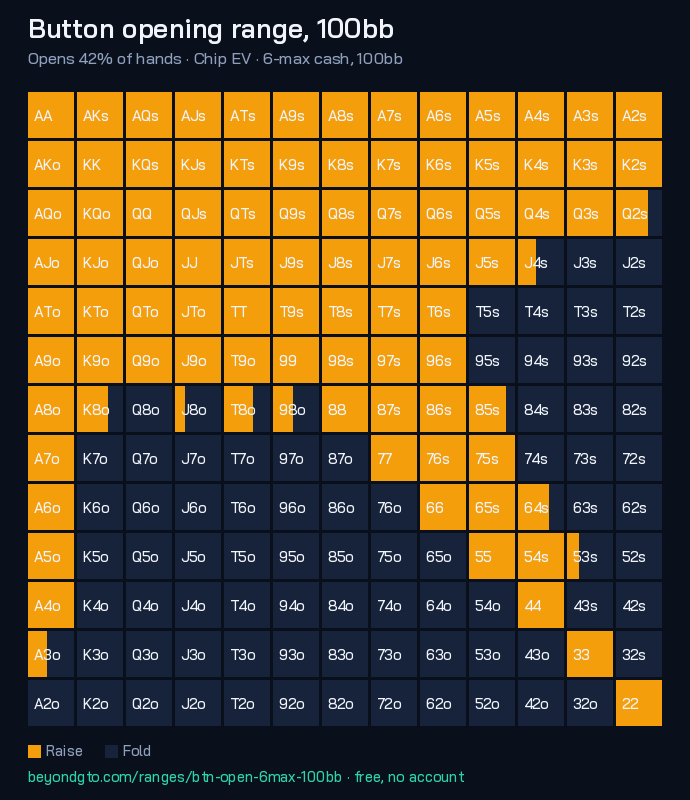
CO · 100bb · Chip EV
opens 28% of hands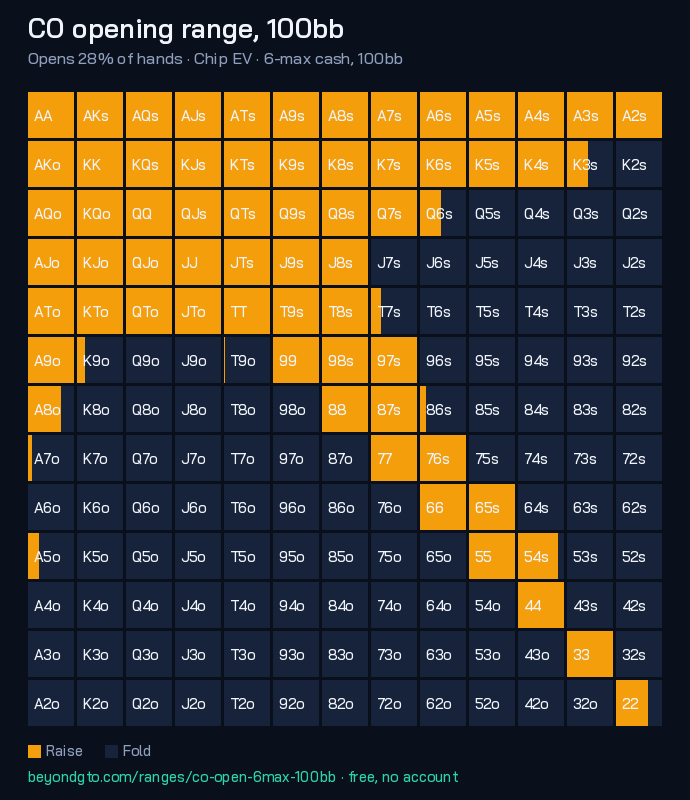
HJ · 100bb · Chip EV
opens 22% of hands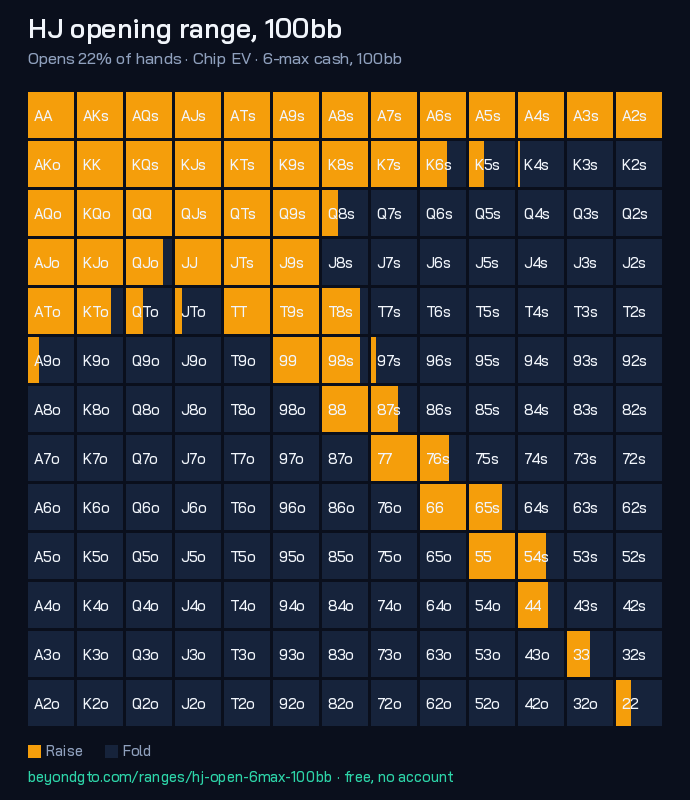
LJ · 100bb · Chip EV
opens 17% of hands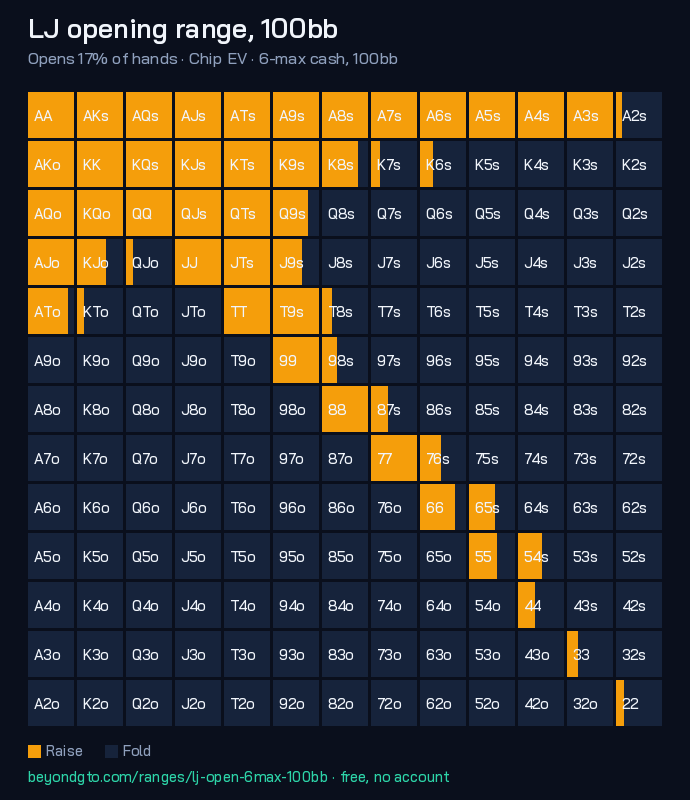
Small Blind · 100bb · Chip EV
opens 44% of hands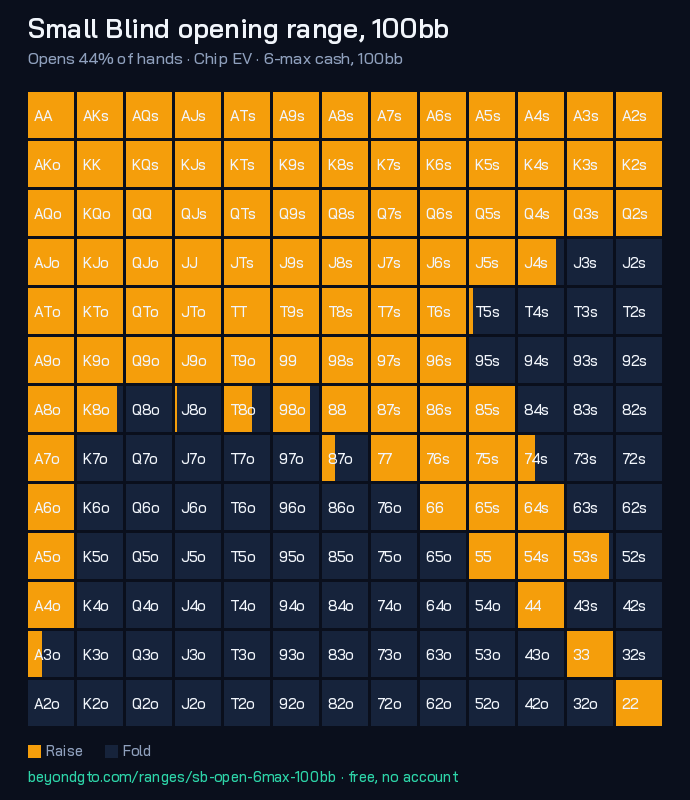
Button · 15bb · Chip EV
opens 38% of hands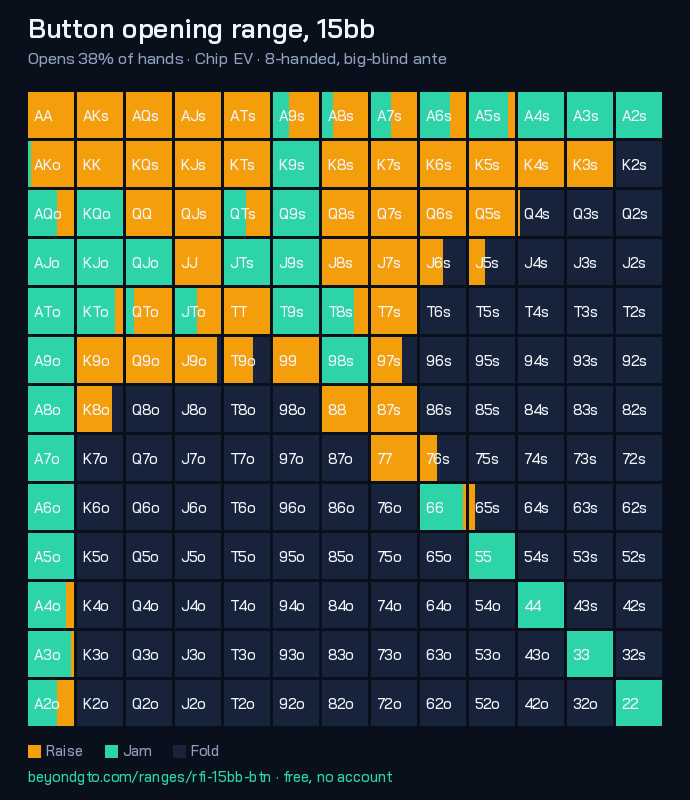
LJ · 20bb · Chip EV
opens 22% of hands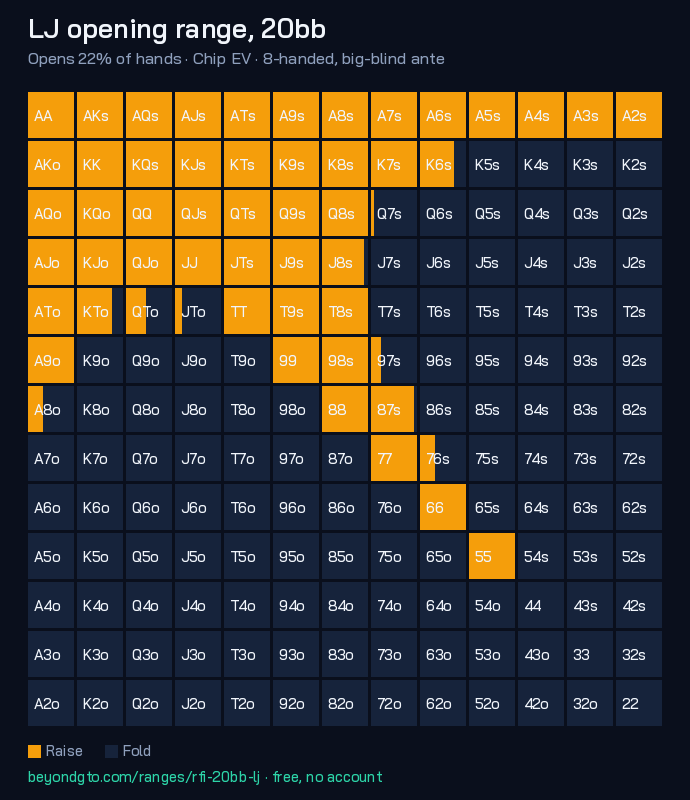
Button · 40bb · Chip EV
opens 52% of hands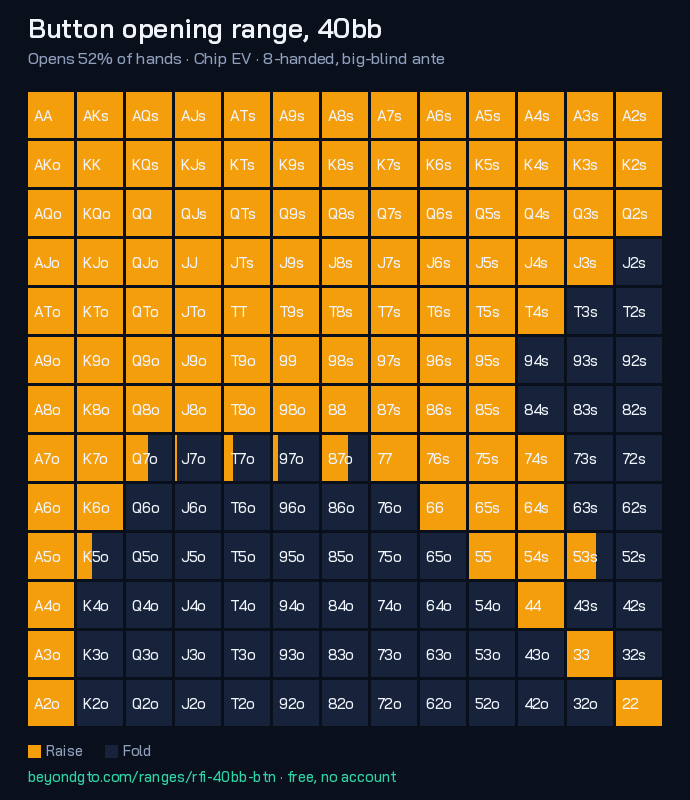
How to read an opening range
Each chart shows what to do with every starting hand when the action folds to you: raise (amber), limp or call where the tree allows it (blue), move all in (teal) or fold (navy). A split cell is a mixed strategy, raised some of the time and folded the rest, and the split shows the frequency. The percentage above each chart is the share of all hands opened, weighted by combinations.
Position drives everything. In 6-max cash at 100 big blinds the first-in opening range runs LJ 17%, HJ 22%, CO 28%, Button 42%, Small Blind 44%. The lojack, first to act with five players behind, opens less than half as many hands as the button; every seat that folds in front of you makes the next hand worth opening.
Why the small blind opens more than the button
The small blind opens 44% against the button's 42%, which looks wrong until you count who is left. The button has two players behind it and will play the pot in position; the small blind has only the big blind to beat and already has half a blind invested, so folding costs more and winning the blinds uncontested is easier. The price of that wider range is that the small blind plays out of position when called, which is why its open is 3 big blinds rather than 2.5 and why it almost never limps in this tree.
Tournaments: how the stack changes the open
From the button in an eight-handed tournament with a big-blind ante, the first-in range goes 10bb 41% (33% as a shove), 12bb 41% (26% as a shove), 15bb 38% (19% as a shove), 17bb 46% (13% as a shove), 20bb 42%, 23bb 44%, 25bb 45%, 30bb 48%, 35bb 49%, 40bb 52%, 50bb 53%, 60bb 53%, 100bb 56%. From the lojack it goes 10bb 23%, 12bb 23%, 15bb 20%, 17bb 22%, 20bb 22%, 23bb 23%, 25bb 24%, 30bb 24%, 35bb 24%, 40bb 24%, 50bb 23%, 60bb 22%, 100bb 23%. Two things move together. Deeper stacks widen the button because position is worth more when there are more streets to play; and as stacks fall towards 15 big blinds, part of the range stops raising and starts shoving, which is where these pages hand over to the push/fold charts. Early position changes far less with depth: with five or six players still to act, the hands that are worth opening are roughly the same at 20 big blinds and at 100.
Cash and tournaments at the same depth
At 100 big blinds the button opens 42% in 6-max cash and 56% in the tournament tree. The tournament is wider for two reasons that have nothing to do with stack size: the big-blind ante adds a full blind to every pot, so there is more to win uncontested, and tournament play has no rake taken from the pot, which makes marginal opens cheaper. Use the cash ranges for cash and the tournament ranges for tournaments; the difference is the structure, not the depth.
What these ranges assume, and when to adjust
- First in. Every chart is for a pot nobody has entered. Facing a raise is a different decision; see the facing-a-raise charts. Facing limpers, open a little tighter than the chart and bigger.
- Sizes. The cash tree opens to 2.5 big blinds from every seat except the small blind, which opens to 3. Raising larger lets you open slightly tighter; raising smaller, slightly wider.
- Table size. The cash ranges are 6-max, where the first seat is the lojack. At a full-ring cash table, open the first three seats a few percent tighter than the lojack chart. The tournament ranges are eight-handed with a big-blind ante.
- Opponents. The ranges assume the blinds defend correctly. Against blinds that fold too much, open wider from late position; against a 3-bettor who is out of line behind you, tighten the hands that cannot stand a 3-bet.
The full method is on the methodology page; every starting hand also has its own page showing what each of these charts says about it.
Common mistakes
- Opening the same range from every seat. The gap between the lojack and the button is the largest effect on this page. A lojack range opened from the button leaves money on the table; a button range opened from the lojack bleeds it.
- Limping. The cash tree does not limp from any seat. A limp invites a raise from a player with position, and the hands good enough to play are good enough to raise.
- Folding the small blind too much. With only one player left to beat, the small blind's range is wider than most players find comfortable.
- Treating a mixed cell as a coin flip. A hand raised 30% of the time is a hand that is close to neutral; against a table that defends poorly it becomes a raise, against one that 3-bets a lot it becomes a fold. The mix tells you which hands your reads should move first.
Questions
- What is an opening range?
- The set of hands to raise with when you are first into the pot, by seat. In 6-max cash at 100 big blinds the solver opens 17% of hands from the lojack, 22% from the hijack, 28% from the cutoff, 42% from the button and 44% from the small blind.
- What percentage of hands should you open from the button?
- About 42% in 6-max cash at 100 big blinds, raising to 2.5 big blinds. In an eight-handed tournament with a big-blind ante the button opens more, 56% at 100bb and 52% at 40bb, and at 15 big blinds part of the range shoves instead of raising.
- Why does the small blind open more hands than the button?
- Because it has only the big blind left to beat and half a blind already invested. The solver opens 44% from the small blind against 42% from the button, but to 3 big blinds rather than 2.5, and it plays those hands out of position when called.
- Should you limp from the small blind?
- Not in this tree: the 6-max cash ranges are raise or fold from every seat. Limping strategies exist in some tournament trees at short stacks and in some live games, but they are not what these charts show.
- What raise size do the ranges use?
- In 6-max cash, 2.5 big blinds from every seat except the small blind, which raises to 3. The tournament ranges use the tree's own sizes, shown on each chart, and shove outright with part of the range at 15 big blinds and below.
- Do these ranges work for full-ring cash games?
- As a starting point. The first seats at a nine-handed table should open a few percent tighter than the lojack chart, because more players are left to act; from the hijack onward the 6-max charts apply almost unchanged.
- What is the difference between an opening range and a push/fold chart?
- An opening range is for stacks deep enough to raise and still fold to a re-raise, roughly 20 big blinds and up. A push/fold chart is for stacks where moving all in is the only raise worth making. The tournament ranges here show the handover: at 15 big blinds part of the range raises and part shoves.
- Can I download the ranges?
- Yes. Each chart has a PNG on its page, and the full set is in the free chart-pack PDF linked on this page. No account is needed.
Each cell shows the GTO open frequency — the % of all hands opened first-in. Click any cell for the full range grid and a trainer.
More free resources