C-Betting Strategy on Dry Boards: Size and Frequency
Dry boards demand a specific c-betting approach. Learn the right sizes and frequencies from solver analysis.
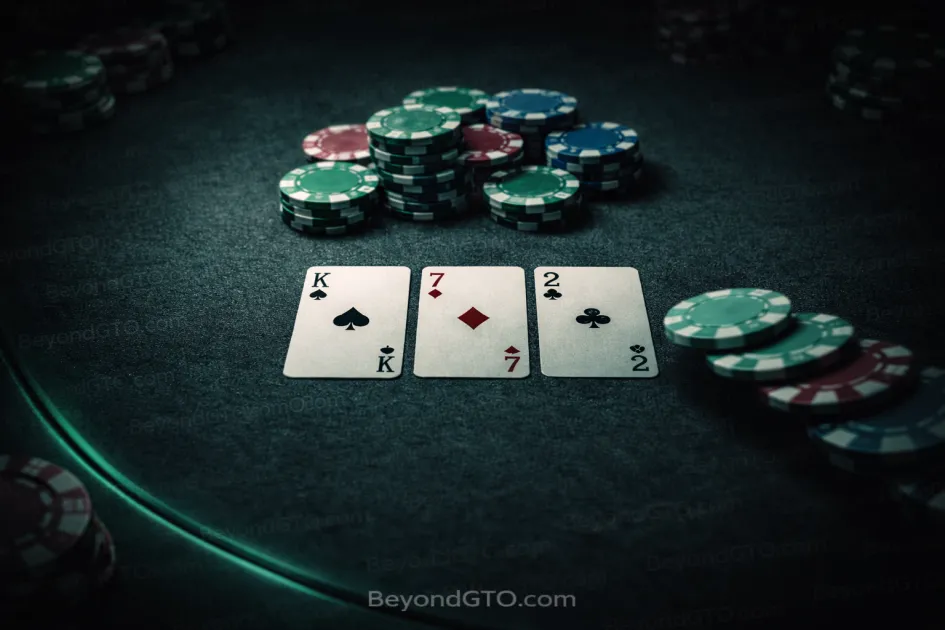
When you continuation bet on a dry board like K♠ 7♣ 2♦, you're making one of the most fundamental decisions in no-limit hold'em. Yet even experienced players frequently misapply c-betting strategy on these textures, either betting too large, too small, too often, or not often enough. The consequences compound throughout a session—bluffing off chips with oversized bets, missing value with undersized ones, or failing to realize your equity by checking back too frequently.
Dry boards present unique strategic considerations that differ dramatically from connected or monotone textures. On a board like K♠ 7♣ 2♦, there are fewer draws to protect against, opponent ranges are generally capped and weak, and the preflop aggressor typically has a substantial range advantage. These factors influence both how often we should c-bet and what size we should use. Modern solver analysis has revealed that many "conventional wisdom" approaches to dry board c-betting are far from optimal, costing players significant EV over time.
This article will break down the GTO approach to c-betting dry boards, examining the strategic principles that govern sizing and frequency decisions. We'll explore why certain sizes work better than others, how to adjust based on position and stack depth, and most importantly, how to implement these concepts in real games against thinking opponents.
Key Concepts
What Defines a Dry Board
Before diving into strategy, we need to precisely define what constitutes a dry board. In poker terminology, dry boards are characterized by:
- Minimal connectivity: Cards are not sequential or closely spaced (K72, A95, Q63)
- Rainbow or two-tone suits: No immediate flush draws or limited flush possibilities
- Few straight draw combinations: The board structure makes straight draws rare or impossible
- Capped opponent ranges: The board hits the preflop aggressor's range more than the caller's range
Classic examples include K♠ 7♣ 2♦, A♥ 8♠ 3♣, and Q♦ 6♥ 2♠. These boards contrast sharply with wet textures like J♠ T♠ 8♥ or 9♦ 7♦ 6♣ where numerous draws exist and both players' ranges are less defined.
Range Advantage and Nut Advantage
The preflop raiser typically has a significant range advantage on dry boards, especially those with a high card. In a button versus big blind single raised pot, when the flop comes K♠ 7♣ 2♦, the button's range contains far more king-x combinations than the big blind's range. The button opens hands like KQ, KJ, KT, K9s profitably, while the big blind only continues with these hands (and often 3-bets some of them preflop).
This range advantage extends to both value hands and the overall distribution of equity. Solver analysis shows the button typically has 53-57% equity on these boards—a substantial edge that justifies aggressive c-betting. Additionally, the button has the nut advantage, meaning when either player has a very strong hand, it's more likely to be the button. The button's range includes overpairs like AA, KK, QQ while the big blind rarely has these hands given their preflop calling action.
Optimal Bet Sizing on Dry Boards
One of the most important findings from GTO solver research is that dry boards favor smaller c-bet sizes than wet boards. While connected boards often call for 75% pot or larger bets to deny equity to draws, dry boards typically prefer sizes between 25-40% pot.
Why do solvers prefer small sizes on dry textures? Several factors converge:
- Opponent's range is capped and weak: With few strong hands, villain cannot effectively punish small bets
- Limited draws to protect against: There's no urgency to charge drawing hands
- Polarization is unnecessary: We can bet a merged range of value and bluffs at a small size
- Stack preservation: Small bets allow us to get to showdown cheaply when behind while building pots when ahead
- Higher frequency possible: Smaller sizes enable more frequent betting without risking too much equity
In BeyondGTO training simulations of BTN vs BB scenarios on K72r, the solver typically uses a 33% pot c-bet size as its primary option, betting this size approximately 70-80% of the time with a well-constructed range. This contrasts with boards like JT8 where 75% pot or even overbet sizes become standard.
Frequency Considerations
The frequency with which you should c-bet dry boards depends heavily on position, but generally, the preflop raiser should be betting at high frequency—typically 60-80% of their range. This high frequency is sustainable because:
- The small sizing risks less
- Your range advantage is significant
- Checking back loses too much equity with hands that have some showdown value but benefit from fold equity
- Many hands in your range want to bet both for value and protection
Let's examine a specific example. On K♠ 7♣ 2♦ from BTN vs BB, the solver c-bets hands like:
- Value: All Kx (top pair), overpairs AA-QQ, some 77 and 22 (though these sometimes slowplay)
- Thin value/protection: QJ, QT, JTs, medium pairs like 99-TT
- Bluffs: A5s-A4s (backdoor equity), some suited connectors that missed, occasionally unpaired broadway
This creates a robust betting range that's difficult to exploit. The key is that we're not purely polarized—we're betting many medium-strength hands that benefit from fold equity and pot building, not just the top and bottom of our range.
Multiway Considerations
When facing multiple opponents, c-betting frequency should decrease substantially on dry boards. While heads-up you might bet 70% of hands on K72r, in a three-way pot this might drop to 45-55%. The reasoning is straightforward: with multiple opponents, the probability that someone connected with the board increases, and your range advantage diminishes.
However, when you do bet multiway on dry boards, sizing should generally increase—from 33% pot heads-up to perhaps 50-60% pot three-way. You need to provide worse odds to multiple opponents, and the pot grows more substantially with multiple callers, making larger bets more palatable risk-wise.
Practical Application
Constructing Your C-Betting Range
At the table, you won't have time to calculate precise equilibrium strategies, but you can follow a simplified decision tree. When a dry board appears, ask yourself:
Step 1: Assess your range advantage. Did the board favor your preflop range or your opponent's? On A-high and K-high boards as the preflop raiser, the answer is usually "mine." On low boards like 7♠ 5♣ 2♦, the situation is more nuanced—you still have overpairs, but the caller can have more connected holdings.
Step 2: Choose your primary size. On most dry boards, default to a small size—33% pot is an excellent starting point. This allows you to bet frequently without overcommitting chips.
Step 3: Categorize your hand. Does your hand want to bet or check?
- Clear value hands: Always bet (top pair or better)
- Marginal made hands: Usually bet for protection and pot building (medium pairs, weak top pairs)
- Air with backdoor equity: Bet at a balanced frequency
- Pure air with no equity: Often check
- Strong showdown value: Mix between betting small and checking (like QJ on K72)
Adjusting to Stack Depth
Stack depth significantly impacts c-betting strategy on dry boards. With deeper stacks (150bb+), you should increase checking frequency even on dry boards because:
- Starting a large pot with marginal holdings creates difficult later-street decisions
- Implied odds favor slower play with nutted hands
- The risk-reward of bluffing diminishes when you're betting small relative to the remaining stacks
Conversely, with shorter stacks (30-50bb), betting frequency should increase. Getting chips in while you have equity becomes more urgent, and the simplified later-street play favors straightforward betting lines.
Example Hand: BTN vs BB on K♠ 7♣ 2♦
Let's walk through a complete example. You open BTN with A♥ 5♥, BB calls. Flop comes K♠ 7♣ 2♦ (pot: 4.5bb, stacks: 100bb effective).
Your hand has backdoor flush equity and an overcard, but missed the flop entirely. Should you c-bet?
In a solver-based approach, this hand bets approximately 50-60% of the time for 33% pot (1.5bb). The mixed strategy reflects that you have some equity and benefit from fold equity, but don't need to bet every air combination to maintain range balance. When you do bet and face a raise, you have a clear fold. When you bet and get called, you can continue your story on many turn cards—any ace, heart, or card that appears to complete a draw (like a 9 or 6) gives you options to barrel or realize your equity.
Compare this to a hand like Q♠ J♠ on the same board. This hand actually plays better as a check much of the time because it has reasonable showdown value and can comfortably call a delayed bet on many turns. Betting risks fold equity from worse hands while not gaining much from better hands folding.
Exploitative Adjustments
While GTO strategy provides the baseline, exploitative adjustments generate additional profit against typical opponents:
- Against over-folders: Increase c-bet frequency to 85%+ and include more pure bluffs
- Against calling stations: Decrease bluff frequency, increase value betting, and consider using slightly larger sizes
- Against aggressive opponents: Check back more frequently with marginal showdown value and hands that play poorly against aggression
- Against passive opponents: Bet very thin for value, knowing they won't raise without premium holdings
Common Mistakes
Betting Too Large
The most prevalent error on dry boards is using oversized bets—50% pot or larger—when a smaller size would be more effective. Players often justify this by thinking "I need to protect my hand" or "I want to build a pot," but these rationales don't hold up under scrutiny. On K72r, betting 75% pot with KJ doesn't provide meaningful additional protection because few draws exist, and it simply risks more chips when behind to 77, 22, or better kings.
Large sizing also forces you to check back too many medium-strength hands because your betting range becomes too polarized. This allows observant opponents to attack your checking range, knowing it contains too many vulnerable holdings.
C-Betting Too Infrequently
Some players, reacting to modern advice about "balanced ranges," check back too often on dry boards, believing they need to "protect their checking range." While balance is important, the extreme range advantage on dry boards justifies aggressive betting. Checking back 40-50% of your range on K72 from position is a significant error that allows opponents to realize their equity too cheaply.
The checking range should primarily consist of medium showdown value hands (like QJ, JTs), some strong hands for deception (occasionally slowplaying sets), and pure air with no backdoor equity. Everything else should lean toward betting small.
Mindless Autopilot C-Betting
Another error is assuming "dry board = always c-bet" without considering your specific hand's properties. Even on dry boards, some holdings play better as checks. For instance, checking back 98s on K72r makes more sense than betting because this hand has minimal fold equity (opponents with a king aren't folding), no showdown value, and no meaningful backdoor equity. Betting would purely be lighting chips on fire.
Failing to Adjust for Position
C-betting strategy shifts dramatically based on whether you're in position or out of position. Out of position (like SB vs BTN), you should check more frequently even on dry boards because:
- You'll face more difficult decisions on later streets without position
- Your opponent can float profitably with position
- Pot control becomes more valuable when you'll act first on later streets
The same K72 board that warrants 70% betting frequency from the button might only justify 50-55% frequency from the small blind.
Not Adjusting to Opponent Tendencies Quickly Enough
While GTO provides the baseline, failing to deviate against obvious opponent tendencies leaves significant profit on the table. If you notice an opponent folding to c-bets 80% of the time on dry boards (way above equilibrium), you should immediately expand your betting range to include virtually any two cards. Similarly, against an opponent who never folds to a single c-bet, you should dramatically reduce bluff frequency and bet only hands with showdown value or better.
Key Takeaways
- Use small sizing on dry boards: Default to 25-33% pot c-bets rather than larger sizes. This allows high frequency betting while risking fewer chips.
- Bet at high frequency in position: On dry boards with range advantage, bet 60-80% of your range from position. Don't over-check trying to "balance."
- Construct merged betting ranges: Include value hands, thin value, protection bets, and bluffs with equity. Avoid purely polarized strategies on dry boards.
- Adjust frequency multiway: Decrease c-betting frequency substantially in three-way or four-way pots, but increase sizing when you do bet.
- Consider stack depth: With shallow stacks, increase betting frequency. With deep stacks, check back more often to avoid creating bloated pots with marginal holdings.
- Recognize position matters: Out of position, check more frequently even on favorable dry boards. Position amplifies the value of aggressive betting.
- Make exploitative adjustments: While knowing GTO strategy provides your baseline, quickly adjust against opponents who deviate significantly from equilibrium play.
- Practice with training tools: Platforms like BeyondGTO allow you to drill these scenarios until proper sizing and frequency become second nature, helping you move beyond mechanical play into true strategic understanding.
Mastering c-betting strategy on dry boards forms a cornerstone of profitable poker play. These situations arise in virtually every session, and the edges compound significantly over thousands of hands. By implementing smaller, more frequent bets with properly constructed ranges, you'll capture more of your theoretical equity while making yourself difficult to exploit. Continue to Series #3 where we'll explore the opposite situation: c-betting strategy on wet, connected boards where protection and sizing considerations flip dramatically.
Solver data for this topic
Ready to put this into practice?
Drill these spots against the solver, get EV feedback the instant you act, and see exactly where your line diverges from GTO.
Level Up Your Poker Strategy
Join thousands of players getting weekly GTO insights, strategy breakdowns, and training tips straight to their inbox. Free forever.
No spam, ever. Unsubscribe anytime.
You're in!
Aleks Nguyen
NL1k+ Reg, GTO Coach
Writes the solver-decoded studies on this site: the flop c-bet, 3-bet and check-raise series, and the facing-a-raise and opening-range pages they draw on. Plays mid-to-high-stakes 6-max cash online and coaches preflop construction and range analysis. His method notes state the exact tree and decode date behind every number.