Introduction to GTO Poker: What It Really Means
Demystifying Game Theory Optimal play and how to use it as a baseline for your strategy.
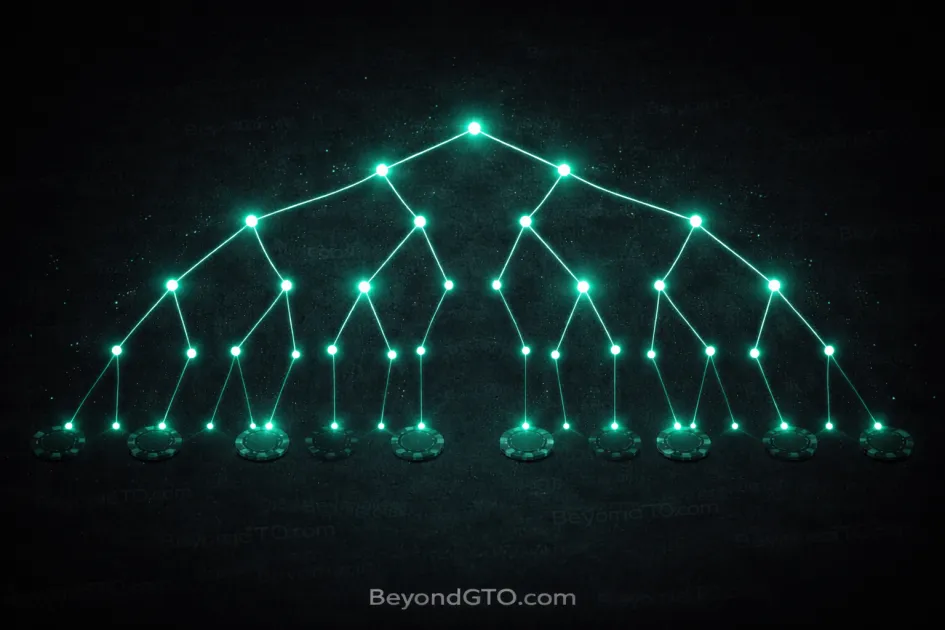
If you've spent any time in poker forums, watching training videos, or listening to commentary, you've undoubtedly heard the term "GTO" thrown around. GTO stands for Game Theory Optimal, and it's become one of the most discussed—and misunderstood—concepts in modern poker strategy. Some players treat GTO as an unbeatable holy grail, while others dismiss it as irrelevant to real-world play. The truth, as usual, lies somewhere in between.
At its core, GTO poker is about playing in a way that cannot be exploited by your opponents. It's a mathematically balanced approach where, if you could execute it perfectly, your opponents would be indifferent to their strategic choices—they couldn't adjust to beat you. This doesn't mean GTO is about winning the most money in every situation; rather, it's about creating a defensive baseline that protects you from being outmaneuvered. Think of it as the poker equivalent of a perfect defensive stance in martial arts: it may not knock your opponent out immediately, but they can't land a clean hit on you either.
Understanding GTO is crucial for modern poker players, even if you never plan to play perfectly balanced yourself. Why? Because knowing what equilibrium strategy looks like gives you a reference point. Once you understand the baseline, you can make informed decisions about when and how to deviate based on your opponents' tendencies. This blog post will break down what GTO really means, how it works in practice, and most importantly, how you can use these concepts to improve your game at the table.
Key Concepts Behind Game Theory Optimal Play
The Nash Equilibrium in Poker
GTO poker is built on the concept of a Nash Equilibrium, named after mathematician John Nash. In poker terms, a Nash Equilibrium is reached when no player can improve their expected value by unilaterally changing their strategy. If you're playing GTO and your opponent is also playing GTO, neither of you can exploit the other—you're in perfect balance.
Here's a simple example: imagine you're heads-up on the river with the nuts, and you bet pot-sized. Your opponent knows you sometimes bluff in this spot. If you bluff too frequently, they should call more often. If you never bluff, they should always fold their mediocre hands. The GTO solution finds the exact frequency where your opponent is indifferent between calling and folding, and you're indifferent to whether they call or fold because your ratio of value bets to bluffs is perfectly balanced.
Balanced Ranges and Frequency-Based Play
Unlike exploitative poker, where you might adjust your strategy dramatically based on a specific opponent, GTO strategy relies on balanced ranges. This means that in any given situation, your range of possible hands should contain an appropriate mix of strong hands, medium-strength hands, and bluffs.
For example, when you raise from the button pre-flop in a GTO framework, you're not raising with just premium hands. Your range might include approximately 45-50% of all possible starting hands, including:
- Premium pairs (AA-JJ)
- Broadway hands (AK, AQ, KQ in various suit combinations)
- Suited connectors (suited hands like 87s, 76s)
- Suited aces (A5s, A4s for their wheel potential)
- Some weaker hands for balance (like K9o, Q9s)
This balanced approach prevents your opponents from easily putting you on a narrow range and exploiting you. If you only raised AA-QQ from the button, observant opponents would quickly realize this and play perfectly against you by only continuing with hands that do well against premium pairs.
Minimum Defense Frequency and Pot Odds
One of the most practical GTO concepts is minimum defense frequency (MDF). This determines how often you need to continue against a bet to prevent your opponent from profitably bluffing you with any two cards. The formula is straightforward: MDF = Pot / (Pot + Bet).
If the pot is $100 and your opponent bets $50, the pot is now $150 and they're risking $50. Your MDF is 100 / (100 + 50) = 66.7%. This means you need to continue (call or raise) at least 66.7% of the time to prevent them from having an immediate profit by betting any random cards. Modern GTO solvers use this principle extensively to determine defending ranges on each street.
Mixed Strategies and Randomization
A key feature of GTO play that confuses many beginners is the concept of mixed strategies. In certain situations, the optimal play isn't to always take the same action with a specific hand—it's to randomize between multiple actions with specific frequencies.
For instance, a solver might tell you to check-raise with pocket tens on a K♠ 9♥ 4♣ flop 30% of the time, call 60% of the time, and fold 10% of the time. This might seem bizarre at first—why wouldn't you just pick the best option? The answer is that by mixing your strategies, you make it impossible for your opponent to exploit you. If you always check-raised with this hand, they could adjust. If you always called, they could adjust differently. By randomizing, you stay unexploitable.
Practical Application: Using GTO at the Tables
GTO as Your Starting Point
The most practical way to think about GTO is as your default strategy before you have information about your opponents. When you first sit down at a table, you don't know if your opponents are calling stations, aggressive maniacs, or tight nits. Starting with a GTO-based approach ensures you're not immediately making major mistakes.
Many professional players use what's called a "GTO-plus" approach: they start with a balanced baseline and then make exploitative adjustments as they gather information. For example, if you notice a player is folding too often to three-bets, you can increase your three-betting frequency against them beyond what GTO would recommend. If they're calling down too light, you can value bet thinner and reduce your bluffing frequency.
Studying with Solvers
Modern poker solvers like PioSolver, GTO+, and others have made GTO study accessible to players at all levels. These tools allow you to input specific scenarios—such as a single-raised pot with specific stacks, positions, and board textures—and see what the equilibrium strategy looks like for both players.
When studying with solvers, focus on understanding the why behind the recommendations rather than memorizing specific outputs. For instance, you might notice that solvers tend to check strong hands more often on certain board textures. Why? Often it's because those boards favor the pre-flop aggressor so much that they can realize equity with their entire range, making checking strategically sound even with good hands to protect the checking range.
Tools like BeyondGTO training software can help you internalize these patterns through repetitive practice, allowing you to recognize similar situations at the table without needing to consult a solver in real-time.
Spot Selection for GTO Implementation
You don't need to play GTO-perfect in every situation—in fact, against weak opponents, you often shouldn't. GTO is most valuable in these scenarios:
- Against strong, thinking opponents: When facing players who are capable of adjusting to your tendencies, a balanced approach prevents them from exploiting you.
- Against unknown opponents: Online poker or the first few orbits at a new table, when you lack reads.
- In high-pressure spots: When the effective stacks are shallow and mistakes are magnified, having a solid baseline prevents costly errors.
- When you're tilted or unsure: Reverting to a fundamentally sound GTO-based approach can prevent you from making desperate, exploitable plays.
Simplifying GTO Concepts for Live Application
Perfect GTO play is impossible for humans—the decision trees are too complex, and we can't randomize perfectly without obvious tells. Instead, focus on these simplified principles:
- Maintain balanced ranges in your most common spots (button opens, blind defense, etc.)
- Understand appropriate continuation frequencies based on pot odds
- Include both value and bluffs when betting or raising
- Don't over-fold or over-call in the face of aggression
- Check strong hands sometimes to protect your checking range
Common Mistakes When Learning GTO
Treating GTO as the "Best" Strategy
The biggest misconception about GTO is that it's the most profitable way to play poker. It's not—it's the most unexploitable way to play. Against a player who's folding 80% of the time to continuation bets, the most profitable strategy is to bet 100% of your range. That's massively exploitative and highly exploitable, but it maximizes your win rate against that specific opponent.
GTO is maximally defensive, guaranteeing you won't lose to an opponent's adjustments, but it often leaves money on the table against players making clear mistakes. The best players understand GTO thoroughly so they know how they're deviating and why.
Over-Relying on Solvers Without Understanding
Simply memorizing solver outputs without understanding the underlying principles is a recipe for disaster. Solvers make assumptions about stack sizes, rake structures, and opponent ranges. If any of these inputs change, the outputs can change dramatically. Players who blindly follow solver solutions often find themselves confused when the actual table dynamic doesn't match their memorized script.
Instead, use solvers to identify patterns. Notice when solvers prefer larger or smaller bet sizes. Observe which hand classes get used for bluffing and why (usually hands with backdoor equity or blockers). Understand the strategic reasons behind the frequencies.
Trying to Randomize Perfectly
When a solver says to take multiple actions with the same hand, don't stress about executing perfect randomization at the table. In practice, you can use factors like the second hand on your watch, the suit of your cards, or your seat number to create pseudo-randomness. However, against most opponents, slight deviations from perfect mixing won't significantly impact your results.
More importantly, focus on getting the overall frequency right across your range rather than perfect randomization with individual hands. If you're supposed to check-raise 25% of the time on a particular flop, make sure you're doing it approximately a quarter of the time with an appropriate mix of value and bluffs.
Ignoring Game Dynamics and Player Types
GTO assumes rational opponents who are also trying to play optimally. But many of your opponents, especially in small-stakes games, are far from optimal. They have leaks, tendencies, and emotional reactions. Playing pure GTO against a recreational player who calls way too much and never bluffs is leaving significant money on the table.
The skill is knowing when to stick close to equilibrium and when to deviate strongly based on your opponent's tendencies. This is where the "game theory optimal" meets practical poker strategy.
Key Takeaways
Understanding GTO poker provides you with a powerful framework for thinking about the game, even if you never play perfectly balanced yourself. Here are the essential points to remember:
- GTO is a baseline, not a goal: Use it as your default strategy and starting point for analysis, then deviate based on your opponents' tendencies to maximize profit.
- Balance is protection: Maintaining balanced ranges with appropriate ratios of value hands to bluffs prevents observant opponents from exploiting you.
- Frequency matters more than individual hands: Focus on taking actions with the right frequency across your entire range rather than perfect play with specific holdings.
- Study the principles, not just the outputs: Understanding why solvers recommend certain plays is infinitely more valuable than memorizing specific scenarios.
- Exploit when possible, defend when necessary: Against weak opponents, deviate strongly toward exploitative play. Against strong unknowns, lean on GTO principles for protection.
- Use training tools effectively: Resources like BeyondGTO can help you develop intuition for balanced play through practice and pattern recognition.
- Don't let perfect be the enemy of good: Imperfect implementation of GTO concepts is still valuable. You don't need solver-level precision to benefit from understanding equilibrium strategy.
As you continue your poker journey, remember that GTO is a tool in your strategic arsenal, not the entire strategy itself. The best players in the world understand equilibrium concepts deeply, which allows them to deviate intelligently and exploit their opponents' mistakes while remaining difficult to exploit themselves. Start by building a solid understanding of balanced play, and you'll find that your overall strategy becomes more coherent, your decisions become clearer, and your results improve across all game types and stakes.
New to poker? Start here
Solver data for this topic
Ready to put this into practice?
Drill these spots against the solver, get EV feedback the instant you act, and see exactly where your line diverges from GTO.
Level Up Your Poker Strategy
Join thousands of players getting weekly GTO insights, strategy breakdowns, and training tips straight to their inbox. Free forever.
No spam, ever. Unsubscribe anytime.
You're in!
Azuki
Poker Student
Writes the fundamentals: pot odds, equity, ranges, position, bet sizing, bankroll. Learning the game in public, and checking every claim against the solver data published on this site before it goes out.