Lock every river at once: the jam that goes from 2% to 22%
Your opponent never bluffs the river and folds everything below top pair top kicker. Lock that read on all 48 rivers at once and the button's all-in goes from 1.7% to 21.7%, 64% on the tens and jacks, for +3.4bb.
Your opponent never bluffs the river. When they check, they have a medium hand at best, and they fold anything below top pair with a good kicker. Every regular has played against this player. The question is what to do about it, and until now a solver could only answer it one river card at a time.
Solve now does it in one go. Deal the turn, choose All rivers, lock how your opponent plays by hand class on every river at once, and the spot re-solves in seconds. One table then shows where to attack, how big, with which hands, and what it is worth in big blinds.
The short version
- A 3-bet pot, button against the small blind on A♦ J♠ 3♣ T♣. The small blind checks the river.
- Under GTO, the button moves all-in on 1.7% of rivers. No single river card reaches 5%.
- Lock the small blind to bet only trips or better, check everything else and fold below top pair top kicker. The button's all-in goes to 21.7%.
- On the tens and jacks, the rivers that pair the board, the button jams about 64% of the time.
- The exploit is worth +3.4bb to the button (15.91bb to 19.32bb), about 9% of the pot.
Why one river at a time was not enough
Node locking has always been the way to test a read: set the opponent's strategy at one decision, re-solve, and see how your own play should change. The catch is the river. After the turn there are up to 48 river cards, and a lock lives on one of them. A read like “he never bluffs the river” is not about one card. Testing it properly meant 48 separate locks, and 48 tables to compare.
A read about a player is a read about hand strength, not about cards. So the new lock works on hand classes: straight flush, quads, full house, flush, straight, set, trips, two pair, overpair, top pair top kicker, top pair weaker kicker, second pair, third pair or lower, ace high, nothing. Every hand in the range is sorted into its class separately on each river card, so a nine-high flush draw is “nothing” on the 2♦ and “flush” on the 2♣. You paint a mix onto the classes once, and it holds on every river.
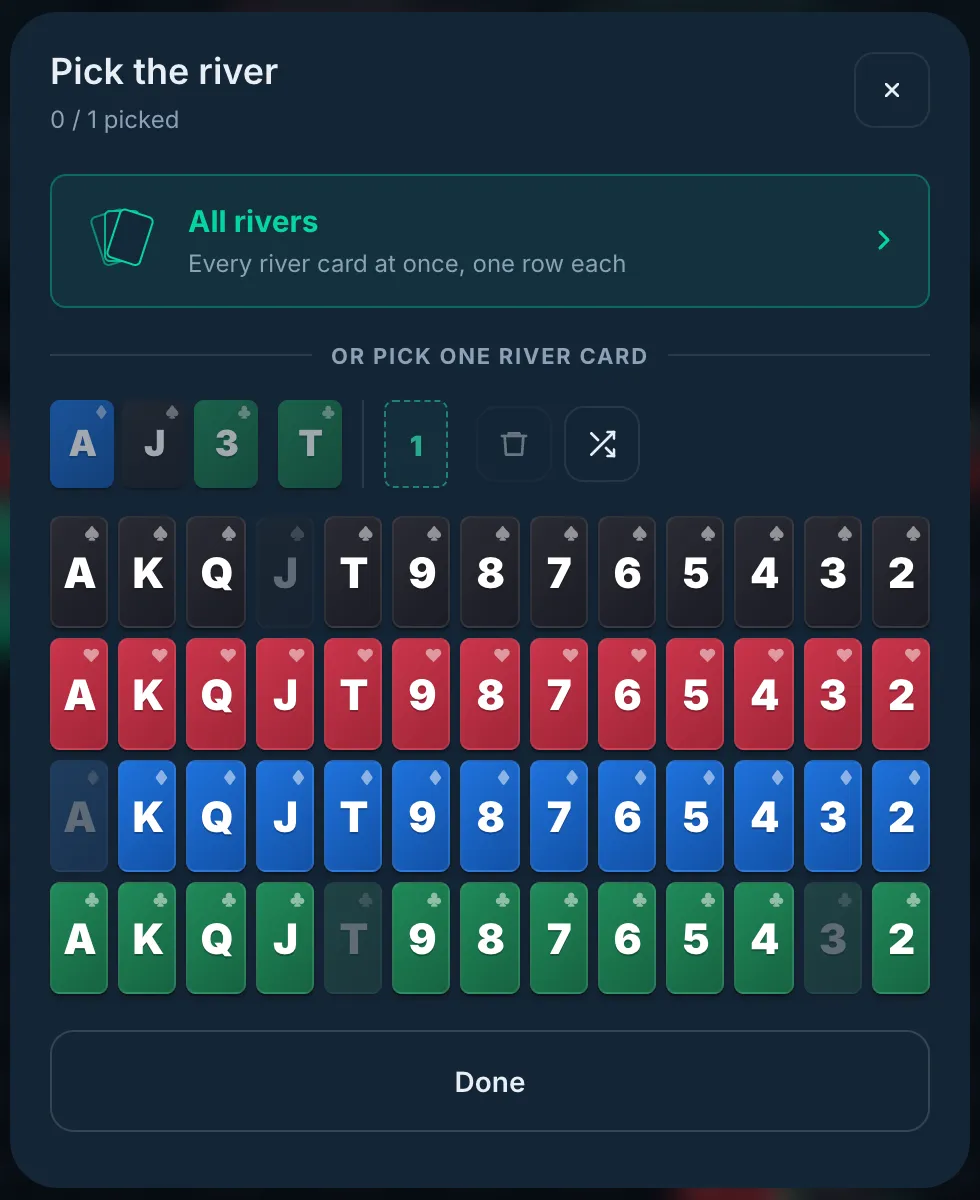
The spot
Cash, 100bb deep. The button opens to 2.24bb, the small blind 3-bets to 11bb and the button calls. The pot is 24.56bb with 88.74bb behind.
- Flop A♦ J♠ 3♣. The small blind bets 6.14bb, a quarter of the pot, and the button calls.
- Turn T♣. Both players check.
- River: all rivers. 36.84bb in the pot, 82.6bb behind. The small blind checks, and the button is to act.
The GTO baseline: the button almost never jams
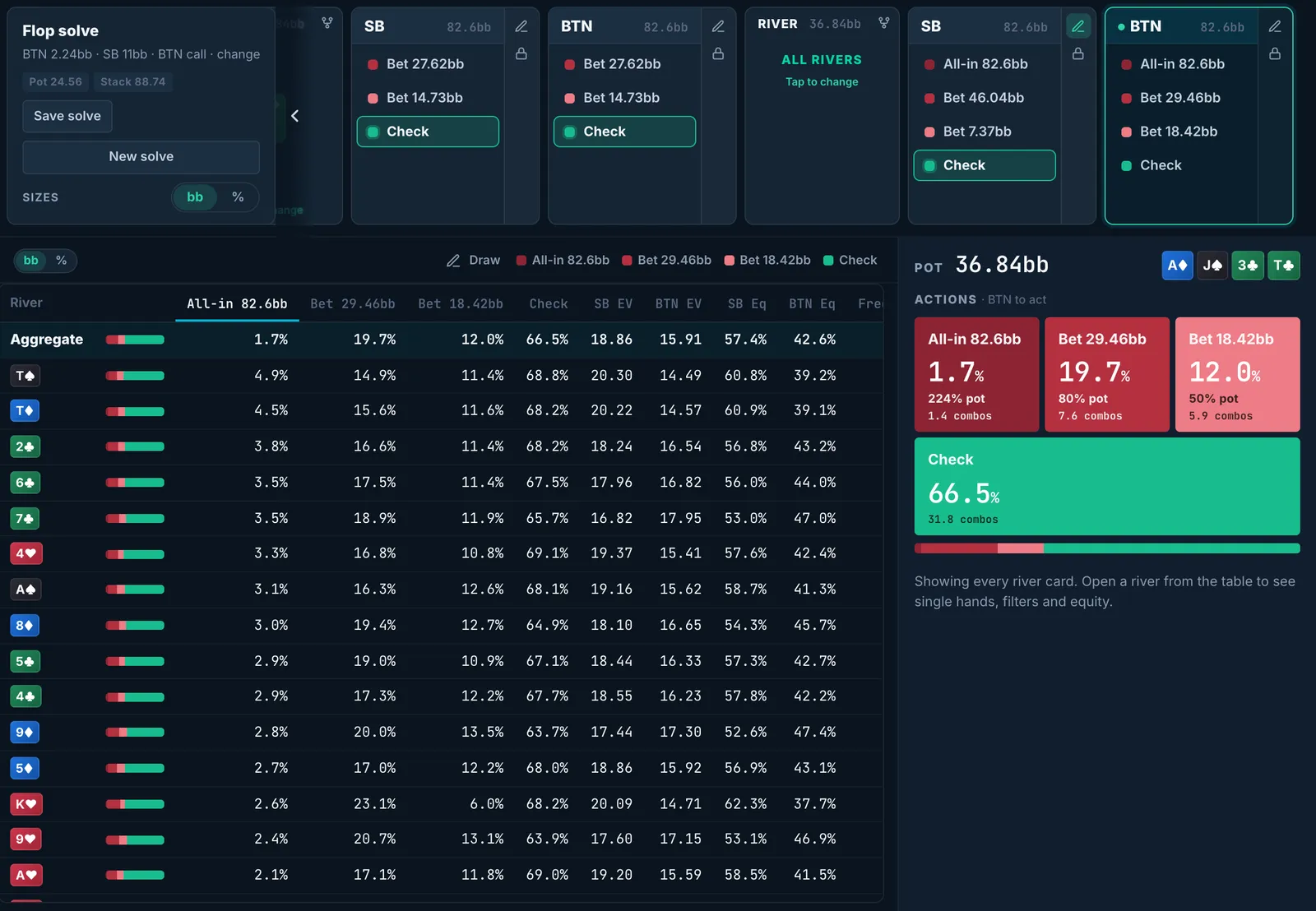
Against a balanced small blind, the button checks back two thirds of the time, and when it bets it prefers the 80% size. The all-in is a rounding error.
| Button, after the small blind checks | Frequency |
|---|---|
| All-in 82.6bb (224% pot) | 1.7% |
| Bet 29.46bb (80% pot) | 19.7% |
| Bet 18.42bb (50% pot) | 12.0% |
| Check | 66.5% |
The button's EV here is 15.91bb and the small blind's is 18.86bb. Even the button's best rivers for the jam, T♠ and T♦, use it under 5% of the time.
The lock: an honest small blind on every river
Now the read. On the small blind's river decision we open the padlock, which on All rivers shows the hand classes instead of the hand grid, and set two mixes:
- Trips or better (set, trips, straight, flush, full house, quads): half all-in, half a 125% pot bet.
- Everything else (two pair, top pair, second pair, third pair, nothing): check, every time.
Then the answers after checking. Facing the button's all-in, the small blind calls only with two pair and top pair top kicker. Facing the half-pot bet, it calls two pair and both top pairs, and folds second pair and worse. That is the player from the first paragraph: no river bluffs, no thin value bets, and a check that caps the range.
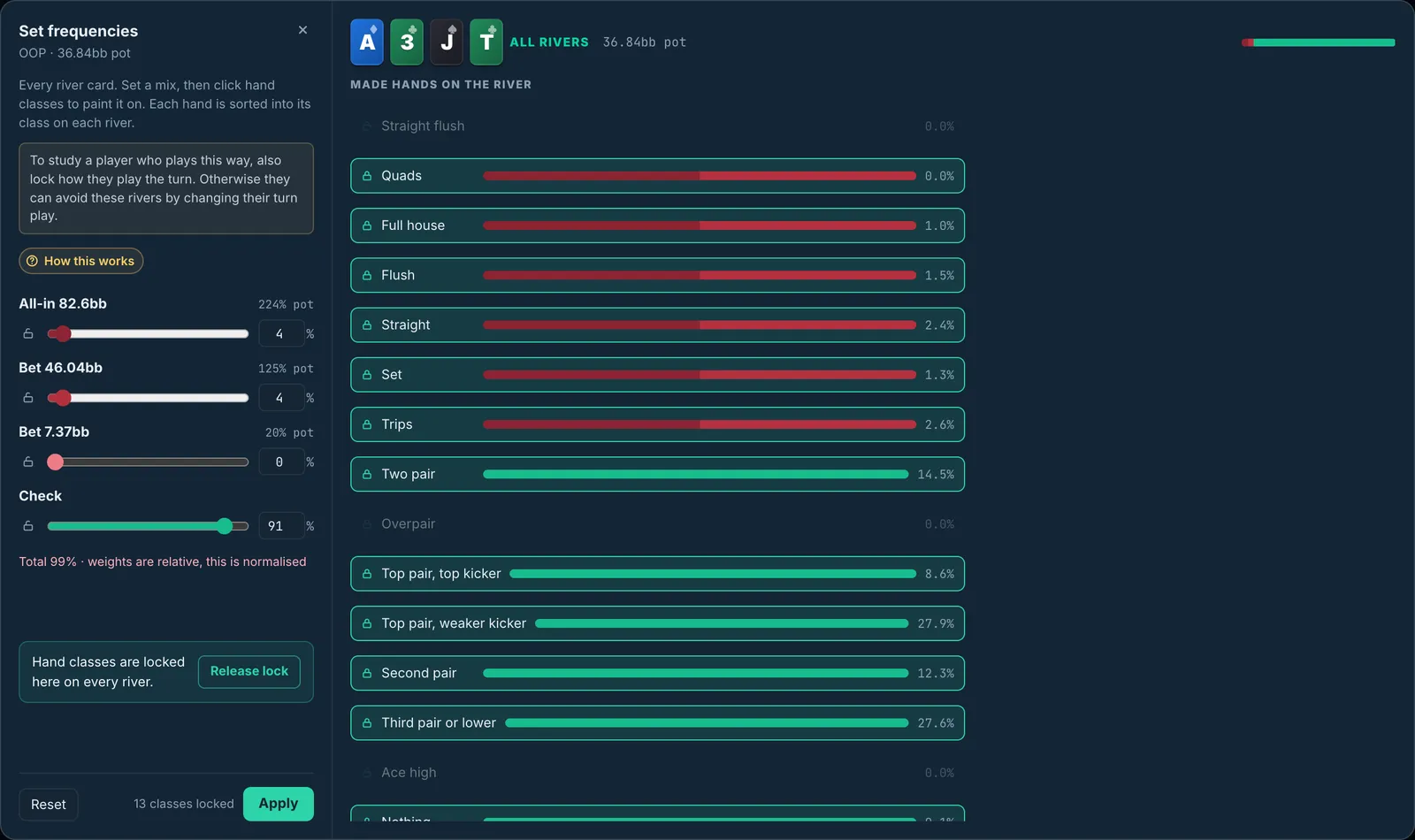
With the lock applied, the small blind checks 91.1% of rivers, against 28.1% under GTO. The solver also lets the turn adjust to the locked river, and the editor reminds you to lock the turn as well when you study a full player profile, so the opponent cannot dodge these rivers by changing how they play the turn.
The result: the jam goes from 2% to 22%
| Button, after the small blind checks | GTO | vs the locked small blind |
|---|---|---|
| All-in 82.6bb | 1.7% | 21.7% |
| Bet 29.46bb (80%) | 19.7% | 0.6% |
| Bet 18.42bb (50%) | 12.0% | 19.0% |
| Check | 66.5% | 58.7% |
| Button EV | 15.91bb | 19.32bb |
| Small blind EV | 18.86bb | 15.50bb |
The 80% bet, the button's favourite size under GTO, almost disappears. Against a player who only calls with two pair and top pair top kicker, a medium bet gets the worst of both: it is too big for the hands that fold anyway and too small to make the calls expensive. The button splits into a jam and a half-pot bet instead, and the exploit is worth 3.4bb, about 9% of the pot.
Which rivers to attack
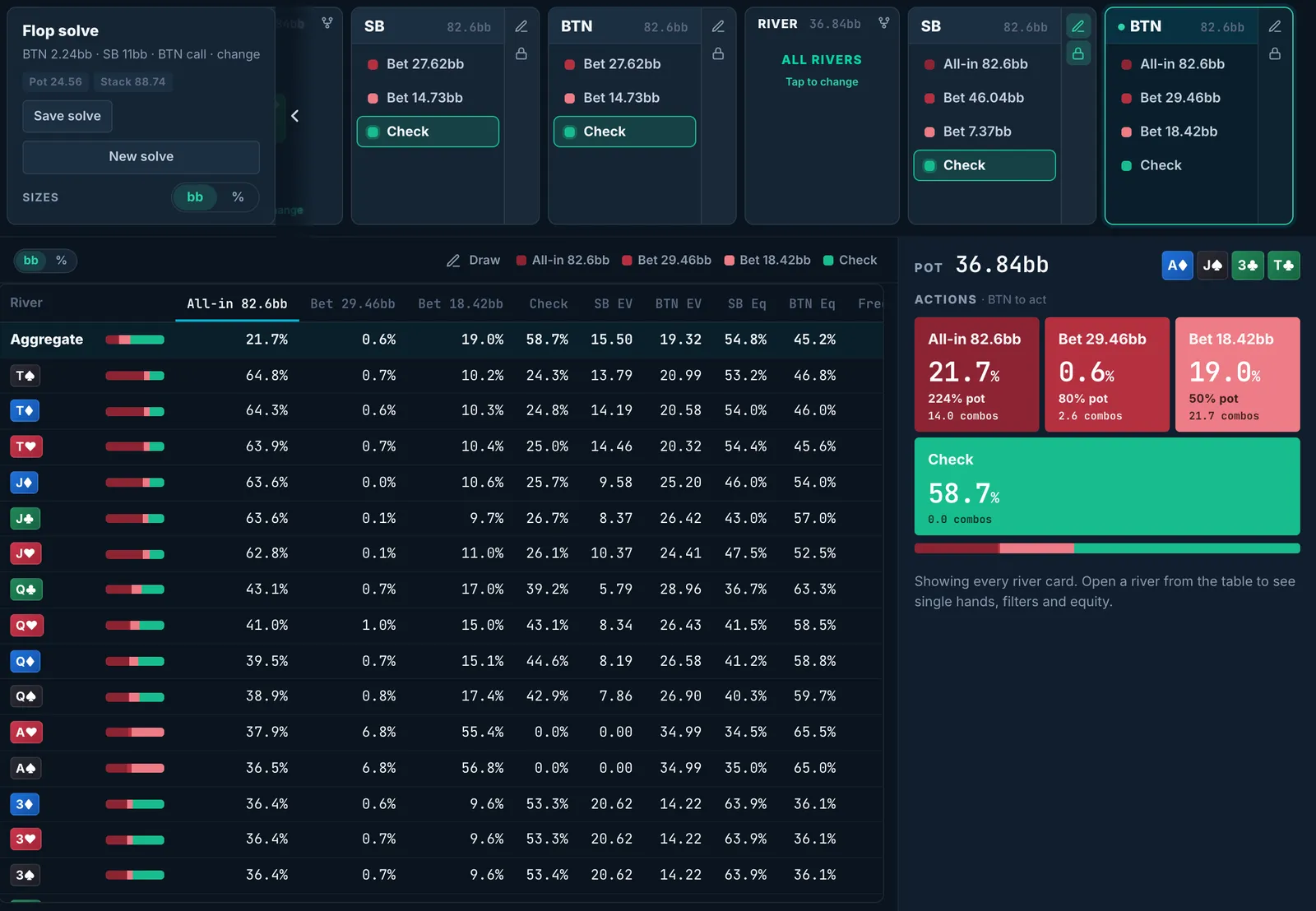
Sort the table by the all-in column and the answer is immediate.
| River | All-in, GTO | All-in, vs the lock |
|---|---|---|
| T♠ | 4.9% | 64.8% |
| T♦ | 4.5% | 64.3% |
| T♥ | 2.1% | 63.9% |
| J♦ | 0.1% | 63.6% |
| J♣ | 0.9% | 63.6% |
| J♥ | 0.1% | 62.8% |
| Q♣ / Q♥ / Q♦ / Q♠ | 0.3% / 1.6% / 0.6% / 0.3% | 43.1% / 41.0% / 39.5% / 38.9% |
| A♥ / A♠ | 2.1% / 3.1% | 37.9% / 36.5% |
The tens and jacks pair the board. On those rivers the button makes trips and full houses, and the small blind has none of them in its checking range, because the lock sends every trips-or-better hand into a lead. Its best checked hand is two pair. The J♦ goes from 0.1% to 63.6%: a river GTO never jams becomes one the button jams nearly two times in three.
Which hands jam
- Value: set 100%, straight 99%, flush 98%, trips 93%. Under GTO the same hands mostly bet 80% (55 to 62%) and jam only 8 to 15%.
- Two pair: mostly the half-pot bet (77%), all-in 16%. It wants calls from top pair, which only call the small size.
- Bluffs: third pair or lower jams 16%, second pair 11%. These are the hands with no showdown value against a range that checked, and the small blind folds everything that beats them anyway.
- Top pair weaker kicker never jams: 75% check, 25% half pot. It beats the second pairs that call nothing, and loses to the hands that call.
What to take to the table
When a player checks every medium hand and folds everything below top pair top kicker, the overbet jam is the play. Jam the nuts for value, because the only hands that call it are the ones it beats. Pick your bluffs from your weakest pairs, because they rarely win at showdown against a range that checked. And make it biggest on the rivers that pair the board.
The bigger lesson is about the question. “How do I play against this player?” is a question about the whole river, and now it gets one answer instead of 48.
Lock your own opponent on every river
Solve a flop or a turn in Solve, deal the turn, pick All rivers, and open the padlock on your opponent's river decision. Locking is on the free plan too: it includes 3 solves a day, no card, and each lock counts as a new solve. Pro solves are unlimited.
All figures are from one solve in BeyondGTO's Solve, read on 5 November 2026 and rounded. Cash, 100bb effective: button opens to 2.24bb, small blind 3-bets to 11bb, button calls (24.56bb pot). Flop A♦ J♠ 3♣, small blind bets 6.14bb, button calls; turn T♣, checked through; river pot 36.84bb with 82.6bb behind. Button sizes on the river: 18.42bb, 29.46bb, all-in. “Aggregate” pools every river card weighted by how often it arrives on this line given both ranges. Locked small blind: river lead with trips or better 50% all-in, 50% 46.04bb; everything else checks; after checking it calls an all-in with two pair and top pair top kicker only, and calls a half-pot bet with two pair and both top pairs. Hand-class figures for the button are its action mix by river hand class across all rivers.
Solver data for this topic
Take your game further with GTO and beyond.
Ready to put this into practice?
Drill these spots against the solver, get EV feedback the instant you act, and see exactly where your line diverges from GTO.
Or play five hands in the trainer right now, no account needed →
Level Up Your Poker Strategy
Join thousands of players getting weekly GTO insights, strategy breakdowns, and training tips straight to their inbox. Free forever.
No spam, ever. Unsubscribe anytime.
You're in!
Aleks Nguyen
NL1k+ Reg, GTO Coach
Writes the solver-decoded studies on this site: the flop c-bet, 3-bet and check-raise series, and the facing-a-raise and opening-range pages they draw on. Plays mid-to-high-stakes 6-max cash online and coaches preflop construction and range analysis. His method notes state the exact tree and decode date behind every number.