The art of bluffing: the complete guide, decoded from the solver
One hand followed from flop to river in the solver: why the worst hands bluff and the middle checks, how each bet size gets its own bluffs, why queen-five jams where queen-six never does, which bluff-catchers call, and how stack depth, ICM and real opponents change it all.
Every poker player knows the feeling. The river is a blank, your draw missed, and the only way you win the pot is if the other player folds. Do you fire, or do you give up? Most players answer that question by feel, and feel is where the money leaks: they bluff with hands that could have won by checking, pick a size because they are bluffing, ignore who is in the pot, and then judge the decision by whether it worked.
This guide replaces the feel with a method. We followed one hand from the flop to the river in our solver database, decoded what the solver does with every hand at every decision, and checked the result against the maths. The short version: a good bluff is a hand that cannot win by checking, holds a card the other player needs, and is bet at the size its value hands use. Everything below is the evidence for that sentence, and the exceptions to it.
1. The price of a bluff
A player who never bluffs is easy to play against: when they bet, you fold everything that does not beat a value hand, and their value bets stop getting paid. Bluffs are what make your value bets profitable. The question is never whether to bluff but how many bluffs your bet can carry, and that is arithmetic.
A pure bluff, a hand that never wins when called, needs the other player to fold a share of the time equal to bet ÷ (pot + bet). And if you want the other player to be indifferent between calling and folding with their bluff-catchers, the share of bluffs in your betting range is bet ÷ (pot + 2 × bet). Their side of it, how often they must continue so your bluffs do not print money, is the minimum defence frequency.
| Bet size | Bluff must work | Bluffs in the betting range | Defender must continue |
|---|---|---|---|
| 25% | 20% | 17% | 80% |
| 33% | 25% | 20% | 75% |
| 50% | 33% | 25% | 67% |
| 75% | 43% | 30% | 57% |
| Pot | 50% | 33% | 50% |
| 150% | 60% | 38% | 40% |
| 200% | 67% | 40% | 33% |
Two things to notice. Bigger bets need more folds, but they also carry more bluffs: at a pot-sized bet a third of your bets can be bluffs, at a quarter-pot bet only one in six. And none of this depends on your cards. It is the price list, and every decision in this guide is about shopping at it. You can run any size through our MDF and value-to-bluff calculator.
Does the solver actually follow the price list? On the river of the hand below it bets two sizes. At 27.5bb into 30.56bb (90% of the pot) the formula says 32.1% of the bets should be bluffs; the solver's betting range is 30.6% bluffs. All in for 85bb (278% of the pot) the formula says 42.4%; the solver bluffs 44.6%. And the big blind folds almost exactly what each bluff needs: 50.5% against the 90% bet (needed: 47.4%) and 75.6% against the all-in (needed: 73.5%).
The rule: the bet size sets how many bluffs you can have. Choose the size first, then fill it with the right number of bluffs.
2. The hand we follow
Every chapter uses the same hand, so you can see one range make every decision: a 100bb cash game, the button opens and the big blind calls. The flop is J♦ 9♣ 4♠: rainbow, no flush possible, with straight draws for hands like T-8, Q-T, K-Q and 8-7.
- Flop (pot 5.5bb): the big blind checks and the button bets 92% of the time, mostly small (1.38bb). The big blind calls.
- Turn 2♥ (pot 8.26bb): the big blind checks, the button overbets 11.15bb (135% of the pot) 38% of the time and checks 56%. The big blind calls.
- River 3♦ (pot 30.56bb, 84.97bb behind): the big blind checks. The button bets 27.5bb 41% of the time, moves all in 17%, and checks 41%.
The river completed nothing for the draws: T-8, Q-T, K-T and K-Q all missed. It did complete one straight, A-5 (ace-two-three-four-five), and 6-5 made a six-high straight. Keep those two straights in mind; they decide the blocker chapter.
3. Which hands bluff the river
Here is every no-pair hand that reached the river, ranked by how often the solver bluffs it.
| Tier | Hands | River bluff |
|---|---|---|
| Tier 1: bluff almost always | Busted straight draws with little high-card value: T-8 (open-ender), T-7 and Q-8 (gutshots) | 94%–99% |
| Tier 1b: the blocker jam | No pair, but holding the 5 that the straight needs: Q5s, K5s | 88%–97% |
| Tier 2: sometimes | King-queen, the overcards that can still beat a missed draw | 19% |
| Tier 3: never | King-ten, queen-ten, K6s, Q6s: high cards that win at showdown often enough to check | 0% |
| Not a bluff at all | Top pair with a weak kicker (J-T, J-6, J-5): too good to bluff, not good enough to bet for value | 0–2% |
The pattern is the cleanest idea in bluffing. The hands that bluff are the ones that cannot win any other way. T-8 is ten-high: it loses to every pair and to most missed draws, so checking wins nothing and betting is free money whenever the big blind folds. King-ten and queen-ten missed the same straight, but king-high and queen-high beat the big blind's own busted draws often enough that checking has real value, so they check every time. King-queen sits between the two and mixes.
The last row matters as much as the first. Top pair with a weak kicker is not a bluff and not a value bet: worse hands will not call a big bet, and better hands will not fold. It checks and takes its showdown. Our introduction to bluffing shows the same split on four flops.
The rule: bluff with the hands that have the least showdown value. If your hand can win by checking, it usually should.
4. Every bet size needs its own bluffs
A bet size that only bluffs is a gift to the other player, and so is one that only value bets. The solver gives each of its river sizes its own value hands and its own bluffs.
| Size | Value hands | Bluffs | Share bluffs | Price-list share |
|---|---|---|---|---|
| 27.5bb (90% pot) | Top pair with a good kicker (A-J, K-J, Q-J), overpairs (A-A, K-K) | Busted straight draws: T-8, T-7, Q-8 | 31% | 32% |
| All in, 85bb (278% pot) | Sets (2-2, 4-4, mostly 9-9), two pair (J-4), some straights (A-5) | Hands holding an ace or a five: Q5s, K5s, A-2, 5-3s; and Q2s | 45% | 42% |
The 90% bet is for hands that want a call from one pair: top pair with a good kicker and the overpairs, paired with the missed draws. The all-in is for the nut end, sets and two pair, paired with a different set of bluffs: hands holding the cards the straights need. A big blind who decides "the big bet is always a bluff" or "the shove is always the nuts" loses either way, because each size is balanced on its own. Our guides to overbetting the river and the polarised ranges behind it go further.
The rule: choose your size by your value hands, then give the size its bluffs. Never pick a size because you are bluffing.
5. The card that picks the bluff
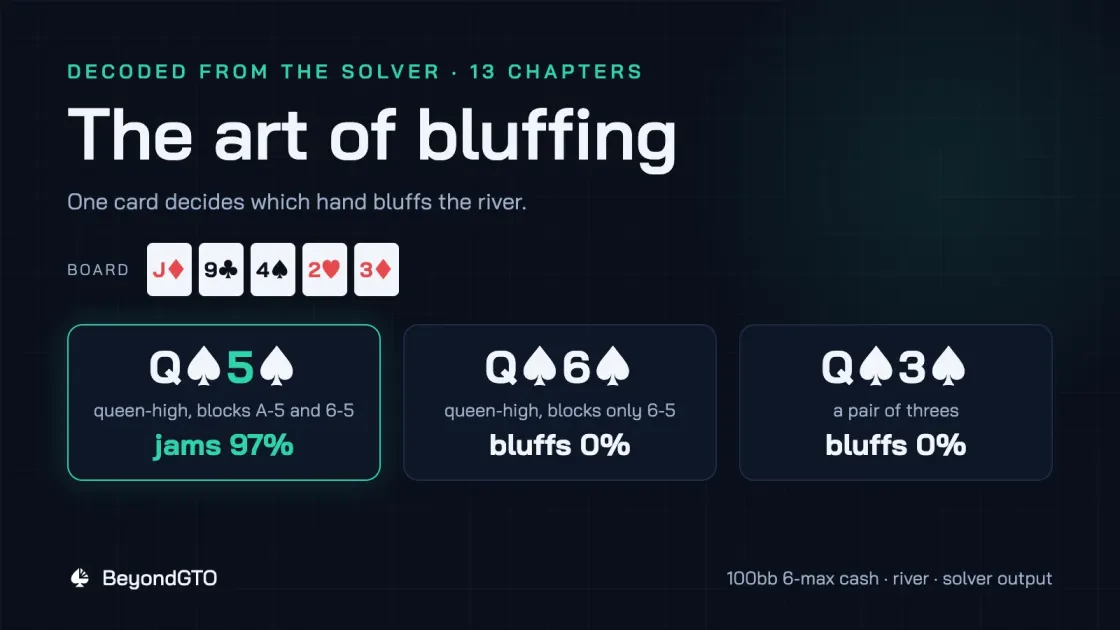
A blocker is a card in your hand that makes a hand in the other player's range impossible. On this river the big blind's best calls against an all-in are straights (A-5 and 6-5), sets and two pair. Hold a 5 and there are fewer A-5 and 6-5 combinations for them to have. Compare three queen-high hands and three king-high hands that differ by one card:
| Hand | Blocks | River jam |
|---|---|---|
| Q♠5♠ (and every Q5s) | Blocks A-5 and 6-5 | 97% |
| Q6s | Blocks 6-5 only | 0% |
| Q3s | Nothing useful (and has a pair of threes) | 0% |
| K5s | Blocks A-5 and 6-5 | 88% |
| K6s | Blocks 6-5 only | 0% |
| K3s | Nothing useful (pair of threes) | 2% |
That is the whole effect in one table. Queen-five jams 97% of the time; queen-six and queen-three never do. The five is the only difference. The same goes for the ace: ace-deuce moves all in 67% of the time even though it has a pair of deuces, because its ace blocks A-5, and 5-3 suited jams 64%. Blockers are not a reason to bluff on their own, but when two hands are equally bad, they pick which one bluffs.
Blockers work in the other direction too: the worst bluff is one that holds the cards the other player folds with. The semi-bluffing study shows the same logic on the flop, where the suit of a draw decides whether it raises.
The rule: when choosing between bluffs, pick the hand that removes the other player's best calls, not the one that removes their folds.
Practise picking your bluffs
The trainer deals you the button against the big blind on every flop and grades each bet, check and size against the solver, hand by hand. 25 graded hands a day are free, no card.
6. In position vs out of position
In position, a bluff always has a way out. If the turn is a bad card for your story you can check behind and see the river for free. That is why the button, after betting 92% of flops, checks the turn 56% of the time: it does not have to choose between bluffing and folding.
Out of position, decide how the hand continues before you put money in, because checking hands the initiative back. The big blind's main bluffing weapon on this flop is the check-raise: it raises the button's small bet 17% of the time, and the bluffs it chooses are mostly draws.
| Big blind hand | Check-raise | Why |
|---|---|---|
| Two pair and sets: 4-4, 9-4s, J-9 | 95%–100% | Value |
| Open-enders: Q-Ts, T-8o | 50%–95% | Semi-bluff |
| Gutshots with overcards: K-Qo, Q-8s, 8-7s | 72%–87% | Semi-bluff |
| Top pair: K-Js, A-Jo, J-To | 10%–91% | Value / protection |
Queen-ten suited, the open-ender with an overcard, check-raises 95% of the time. Hands with no pair and no straight draw rarely do, and the few that do are suited, with backdoor draws to fall back on (king-eight suited raises 52%). Out of position, a bluff needs equity when it is called, because it cannot count on getting to the river cheaply.
The rule: in position, bluff when it is profitable and check when it is not. Out of position, bluff with hands that can improve, usually by check-raising.
7. Choose flop bluffs that can reach the river
The best river bluffs are chosen on the flop. A bet on the flop is the start of a story, and the hands you start it with decide which bluffs you will have on the river. Here is what happened to the button's no-pair hands street by street:
| Hand | On the flop | Flop bet | Turn overbet | River |
|---|---|---|---|---|
| T-8o | Open-ender | 88% | 95% | Bluffs 98% |
| Q-8s | Gutshot + overcard | 98% | 98% | Bluffs 94% |
| Q-5s | No draw, but holds a 5 | 60% | 95% | Jams 97% |
| K-To | Gutshot + overcard | 87% | 100% | Checks 100% |
| A-5o | Wheel draw | 88% | 99% | Makes the straight: bets for value |
| A-Ko | Two overcards, no draw | 85% | 0% | Gave up on the turn |
| K-8o | Nothing | 98% | 2% | Gave up on the turn |
Three groups appear. The draws (T-8, Q-8, K-T) bet the flop and overbet the turn almost every time, because they can still make the best hand; on the river the ones with no showdown value bluff and the ones with some (K-T) give up. Some hands with no draw at all keep firing too: queen-five has nothing on the turn, bets it 95% of the time, and becomes the river's best all-in bluff once the 3 makes its five the card that matters. And the hands with no future (A-K with no draw, K-8) take one cheap stab on the flop and stop: the turn overbet needs hands that can carry the story to the river. Our turn barrelling guide covers the turn decision on its own.
The rule: before you bluff the flop, ask which rivers you will keep bluffing. A flop bluff with no river plan is a donation.
8. Bet the top and bottom, check the middle
Put the river decisions together and the button's range splits into three. The top bets for value (every set, two pair, overpair and top pair with a good kicker bets). The bottom bluffs (the busted draws and the blocker hands). And the middle checks: top pair with a weak kicker checks 98% of the time or more, king-ten and queen-ten check every time.
This is the opposite of how most players bluff. They bluff with their middle (a hand that is "probably behind" but "might be good") and check their worst hands because "nothing can call". The solver does the reverse: the middle of the range is exactly the hands that can win a showdown, and the bottom is exactly the hands that cannot. The checking range ends up 63% no-pair hands that gave up, 18% weaker pairs and 19% made hands. That last slice keeps the checks honest, so the big blind cannot bet every time the button checks.
The rule: bet the top and the bottom of your range, check the middle.
9. The other seat: catching bluffs
Everything above has a mirror. Facing the 90% river bet, the big blind needs to continue about 53% of the time and continues 50%. Which hands do the calling is a blocker question again, in reverse: a good bluff-catcher blocks the other player's value hands and does not block their bluffs.
| Big blind hand (pair of nines) | Blocks value | Blocks bluffs | Continues |
|---|---|---|---|
| A-9o | A-A, A-J, A-5 (value) | Nothing | 100% |
| K-9o | K-K, K-J (value) | K-Q (a few bluffs) | 87% |
| Q-9o | Q-Q, Q-J | Q-8s, K-Q | 0% |
| T-9o | Nothing | T-8, T-7 | 0% |
All four hands are a pair of nines. Ace-nine calls every time because its ace removes A-A, A-J and A-5 from the button's betting range, and blocks none of its bluffs. Queen-nine and ten-nine fold every time because they hold the queens and tens the button bluffs with at this size (Q-8, K-Q, T-8, T-7). Same pair, opposite decisions. And one more: nine-five suited, with a pair of nines and a 5 that blocks the button's straights, turns into a bluff of its own and moves all in 77% of the time. Our guide to bluff-catching on the river works through more spots.
The rule: call with the bluff-catchers that block value, fold the ones that block bluffs.
10. Stack depth and tournaments
Shorter stacks mean fewer streets to tell a story on, and the solver bluffs less on the flop as stacks get shorter. Same flop, same button against big blind, tournament stacks:
| Stack | Button bets the flop | Button checks |
|---|---|---|
| 20bb | 70% | 30% |
| 40bb | 87% | 13% |
| 60bb | 90% | 10% |
| 100bb | 88% | 12% |
The hands that stop betting are the draws. At 100bb they bet the flop to build a pot they can win on later streets; at 20bb, with 18bb behind, there is too little left to bet on later streets, so they check and take their equity to the turn.
| Hand | Flop bet at 20bb | Flop bet at 100bb |
|---|---|---|
| T8s | 6% | 100% |
| 87s | 1% | 98% |
| A5s | 2% | 97% |
| K6s | 6% | 86% |
In a tournament, ICM adds a second rule: the stack that covers yours can steal wider than you can. Near the money bubble, a stack that can bust you risks less of its tournament life in each pot than you do, so it can open and steal with weaker hands. Here is how often the button opens when it is folded to, in four solves near the bubble:
| Button stack | Small / big blind | Situation | Button opens |
|---|---|---|---|
| 50bb | 27bb / 25bb | Chip leader: covers everyone | 62% |
| 28bb | 21bb / 25bb | Covers both blinds | 46% |
| 29bb | 50bb / 42bb | Covered by both blinds | 32% |
| 19bb | 38bb / 36bb | Covered by both blinds | 27% |
A 28bb button that covers both blinds opens 46% of its hands. A 29bb button whose blinds both cover it opens 32%: a third fewer, with almost the same stack. The chip leader opens 62%. If you are the big stack, every medium stack at the table should be your target; if you are the medium stack, the big stack is the one player you should not try to bluff. Our bubble guide and the push-fold charts cover the short-stack side.
The rule: bluff less when stacks are short, and in a tournament, bluff the players you cover, not the players who cover you.
11. Adjusting to real opponents
Everything so far is the baseline: what to do against an opponent who defends correctly. Real opponents do not, and the price list from chapter 1 tells you exactly how to adjust. Take the button's river bluff with T-8: 27.5bb into 30.56bb. Its result depends only on how often the big blind folds.
| Big blind | Folds | Result of the bluff |
|---|---|---|
| Calling station | 30% | -10.1bb |
| Sticky | 40% | -4.3bb |
| Break-even | 47.4% | 0bb |
| Solver (this spot) | 50.5% | +1.8bb |
| Over-folder | 60% | +7.3bb |
| Nit | 70% | +13.1bb |
The adjustment follows directly. Against a player who calls too much, cut bluffs from the bottom of your range and bet more of your middle hands for value: they are now the ones that get paid. Against a player who folds too much, add bluffs: hands like king-queen, which the solver bluffs only 19% of the time, become profitable bets. And against a player who never bluffs, fold your bluff-catchers, starting with the ones that block bluffs (chapter 9).
The trick is to change one thing at a time and know why. Node locking does this exactly: tell the solver "this player folds too much on the river", re-solve, and see which hands start bluffing. Our node locking primer shows how, and you can try a solve in the free poker solver with no account needed.
The rule: play the baseline until you have a reason not to, then adjust only the hands the reason touches.
Find out where your opponents break
Lock the big blind to fold more, or call more, and watch the solver change which hands bluff. Node locking is part of the free allowance: 3 solves a day, no card.
12. Judge the decision, not the result
The big blind folds to the button's 90% bet 50.5% of the time. That means the button's T-8 bluff is called almost half the time, and it is still a profitable bet: 50.5% × 30.56bb won, minus 49.5% × 27.5bb lost, is +1.8bb each time. Checking T-8 wins nothing. A player who stops bluffing after being called twice in a row is reacting to the half of the outcomes they can see and ignoring the half they cannot.
The way to judge a bluff is the same three questions every time. Was the hand one that cannot win at showdown? Did the size have room for it? Did it hold the right cards? If all three are yes, a call is the cost of doing business. If one is no, a fold was luck.
The rule: a called bluff is not a mistake. A bluff with a hand that could have won at showdown is.
13. Eight questions before you bluff
- Can my hand win by checking? If yes, it is probably not a bluff. Check it (chapter 3).
- What size do my value hands want here? Bluff at that size, never at a special bluffing size (chapter 4).
- How many bluffs does that size carry? About a third at pot, a quarter at half pot (chapter 1).
- Which of my bad hands hold the cards they call with? Bluff those first (chapter 5).
- Am I in position? If yes, I can check and take the free card. If not, I need equity, or a check-raise (chapter 6).
- Will I keep bluffing on the next street? If no river makes sense, do not start (chapter 7).
- How deep are we, and who covers whom? Bluff less when short; bluff the stacks you cover (chapter 10).
- What does this opponent actually do? Adjust from the baseline, one leak at a time (chapter 11).
Frequently asked questions
- How often should you bluff in poker?
- As often as your bet size allows: about one bluff for every two value bets at a pot-sized bet (33% of the betting range), one in four bets at half pot, one in six at a quarter pot. On the river in this guide the solver's betting range was 31% bluffs at a 90% bet and 45% at an all-in.
- What are the best hands to bluff with?
- Hands that cannot win at showdown and hold a card the other player needs. On our river: busted straight draws with a ten or queen high (T-8 and Q-8 bluff 98% and 94%), and hands holding the 5 that blocks the straight (Q5s jams 97%).
- Should you bluff with ace-high or king-high?
- Usually not on the river, when it can win at showdown: king-ten and queen-ten checked every time. On earlier streets ace-high often takes one cheap stab and then stops.
- What is a blocker in poker?
- A card in your hand that removes combinations from the other player's range. A good bluff blocks their best calling hands; a good bluff-catcher blocks their value bets.
- How much should you bet when bluffing?
- The same amount you would bet with your value hands in that spot. Bigger sizes need more folds but carry more bluffs; the table in chapter 1 has the numbers.
- Do you bluff less in tournaments?
- With short stacks, yes: the button bet 70% of flops at 20bb against 88% at 100bb. Near the bubble it depends on who covers whom: a button that covers the blinds opened 46% of hands, one that is covered opened 32%.
- How do you know if your opponent is bluffing?
- Count the bluffs their line can contain. At a pot-sized bet a balanced player is bluffing a third of the time; if their story has few missed draws or blockers in it, they are bluffing less than that, and you should fold more.
Go deeper
Start with the two companion pieces: how to bluff in poker (which hands bluff on four flops, and preflop 3-bet bluffs) and semi-bluffing (draws, street by street). For the bet-sizing maths, see value bets vs bluffs and minimum defence frequency. Bluffing before the flop is in our 3-bet study, and the ace-queen study has a textbook 4-bet bluff. The flop spot library shows which hands c-bet on every common flop.
Method: all figures are decoded from solver output in our solver database, read on 22 November 2026. The hand: 6-max cash, 100bb, button opens and the big blind calls; flop J♦9♣4♠ (pot 5.5bb), the big blind checks, the button bets 1.38bb and is called; turn 2♥, the big blind checks, the button bets 11.15bb and is called; river 3♦ (pot 30.56bb, 84.97bb behind). Per-hand figures are the solver's action mix for each hand class, normalised to 100% and rounded. Range-level frequencies (how often the button bets, how often the big blind folds) are the solver's own figures. The share of bluffs in each river betting range and the check-raise groups are reconstructed: each hand class is weighted by its combinations and by how often it took the line to that point, without its preflop range weight, so treat them as close estimates. "Bluff" counts every betting hand weaker than top pair, including the small pairs that bet as bluffs. Stack-depth figures are from chip-EV tournament trees (button vs big blind, single-raised pot) on the same flop. The bubble figures are first-in button ranges from four 8-handed ICM near-bubble solves with the stacks shown. The break-even and price-list figures are arithmetic.
Solver data for this topic
Take your game further with GTO and beyond.
Ready to put this into practice?
Drill these spots against the solver, get EV feedback the instant you act, and see exactly where your line diverges from GTO.
Or play five hands in the trainer right now, no account needed →
Level Up Your Poker Strategy
Join thousands of players getting weekly GTO insights, strategy breakdowns, and training tips straight to their inbox. Free forever.
No spam, ever. Unsubscribe anytime.
You're in!
Aleks Nguyen
NL1k+ Reg, GTO Coach
Writes the solver-decoded studies on this site: the flop c-bet, 3-bet and check-raise series, and the facing-a-raise and opening-range pages they draw on. Plays mid-to-high-stakes 6-max cash online and coaches preflop construction and range analysis. His method notes state the exact tree and decode date behind every number.