How to play ace-queen (AQ): every spot, solved
Ace-queen, decoded from the solver in every spot: suited never 4-bets and never folds to a 3-bet, offsuit folds to a tight open and 4-bets only as a bluff, it shoves at 15bb where ace-king raises, outranks queens on the bubble, and bets big on a queen-high flop where ace-king checks.
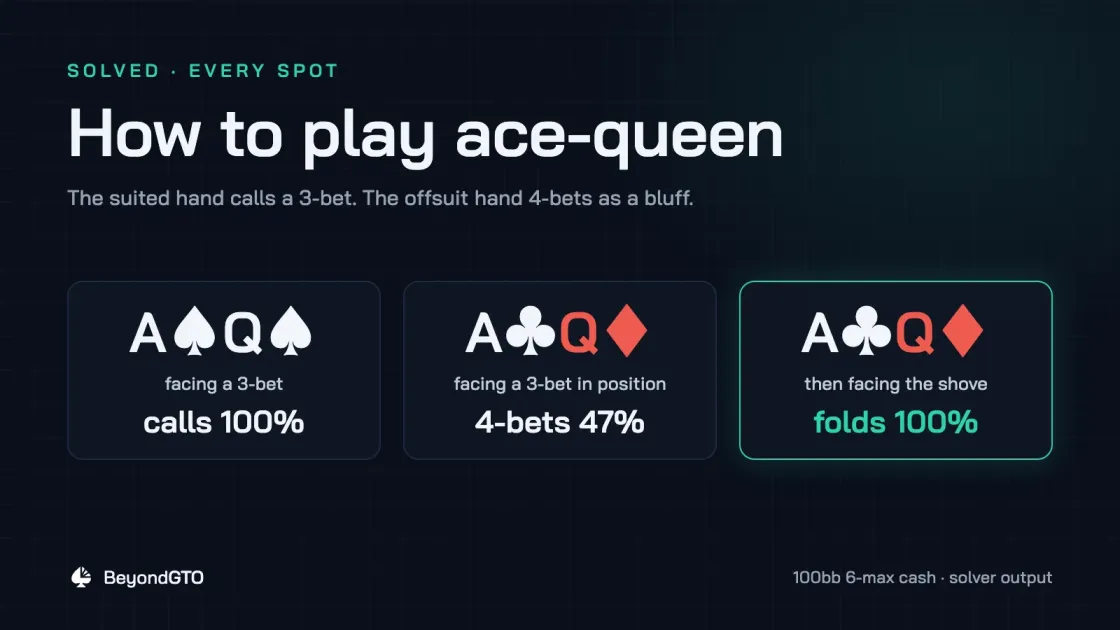
Ace-queen is the hand that looks like ace-king and plays like something else. It is the third-best unpaired hand in the game and an easy open from any seat, which is exactly why it causes trouble: players 3-bet it, 4-bet it and stack off with it as if it were ace-king, and then meet ace-king. The difference between the two is one rank, and almost all of the difference in how to play them comes from that one rank.
We decoded what the solver does with ace-queen in every spot we have: first in from every seat at 100bb in a 6-max cash game and at tournament stacks from 20bb down; facing an open in all fifteen seat-versus-seat matchups; facing a 3-bet, a 4-bet and a 5-bet; on the money bubble; and on twelve flops as the button. The short version: ace-queen suited never 4-bets and never folds to a 3-bet. Ace-queen offsuit folds to an open from a tight seat (61% as the hijack against a lojack open), 4-bets about 45% of the time against an in-position 3-bet, and folds 100% when that 4-bet is shoved on. In other words, the offsuit hand's 4-bet is a bluff. And at 15bb in a tournament, ace-queen offsuit is a shove where ace-king is a raise.
What ace-queen actually is
Ace-queen pairs one of its cards on the flop 32% of the time and by the river 49%, exactly like ace-king. What changes is what it is up against when it pairs. Ace-king is never dominated; ace-queen is dominated by one hand, ace-king, and that hand is in every strong range.
| Against | AQs wins | AQo wins |
|---|---|---|
| Pocket aces | 13% | 7% |
| Pocket kings | 32% | 28% |
| Pocket queens | 34% | 30% |
| Pocket jacks | 46% | 43% |
| Pocket sevens | 48% | 46% |
| Pocket deuces | 50% | 48% |
| Ace-king suited | 29% | 24% |
| Ace-king offsuit | 30% | 26% |
| Ace-jack offsuit | 75% | 74% |
| King-queen offsuit | 75% | 75% |
| Jack-ten suited | 62% | 60% |
All-in before the flop, no board. From our preflop equity chart, rounded.
The table has two halves. Against ace-king, ace-queen is crushed: 26% (offsuit against offsuit), barely better than against kings. Against the hands it dominates, ace-jack and king-queen, it is the one doing the crushing: 74% and 75%. Against pairs from jacks down it is the usual flip (46% suited against jacks, 50% against deuces). So every decision with ace-queen comes down to one question: how much ace-king is in the other range? A loose opener has little of it in relative terms; a player who 3-bets, 4-bets or 5-bets has a lot. The solver's strategy below follows that question almost perfectly.
The queen also blocks less than the king does. Ace-king removes half the aces and half the kings, the two hands that beat it badly. Ace-queen removes half the aces and half the queens, and does nothing about kings or ace-king. That is why the blocker-driven 4-bets and 5-bet calls that make ace-king special do not carry over.
Opening: everywhere, with a tournament twist
In a 100bb 6-max cash game the solver opens ace-queen 100% from every seat, suited and offsuit. In tournaments, the interesting stacks are 12bb and 15bb, where the solve can limp, min-raise or jam:
| Stack | Seat | AQs | AQo | AKs | AKo |
|---|---|---|---|---|---|
| 12bb | UTG | limp 74%, raise 26% | jam | limp | raise 10%, jam 90% |
| 12bb | MP | limp 65%, raise 35% | jam | limp | raise 12%, jam 87% |
| 12bb | LJ | limp 75%, raise 25% | jam | limp 74%, raise 26% | jam |
| 12bb | HJ | limp 90%, raise 10% | jam | limp 85%, raise 15% | jam |
| 12bb | CO | limp 93%, raise 7% | jam | limp 96%, raise 4% | jam |
| 12bb | BTN | limp 79%, raise 21% | jam | limp 77%, raise 23% | jam |
| 12bb | SB | limp 78%, raise 22% | jam | limp | limp 6%, jam 93% |
| 15bb | UTG | raise | raise 99%, jam 1% | raise | raise |
| 15bb | MP | raise | raise 73%, jam 27% | raise | raise |
| 15bb | LJ | raise | raise 29%, jam 71% | raise | raise 97%, jam 3% |
| 15bb | HJ | raise | raise 44%, jam 56% | raise | raise |
| 15bb | CO | raise | raise 43%, jam 57% | raise | raise |
| 15bb | BTN | raise | raise 37%, jam 63% | raise | raise 94%, jam 6% |
| 15bb | SB | limp 31%, raise 69% | jam | limp 52%, raise 48% | limp 77%, raise 23% |
Chip-EV tournament solves, 8-handed, first to act, big-blind ante. "Raise" is a min-raise; "jam" is all-in; "limp" is a call of the big blind (a completion from the small blind). Each row links to the full first-in chart for that seat.
At 12bb, suited ace-queen limps (74% under the gun, 93% from the cutoff) and offsuit ace-queen jams 100% from every seat, the same split the solver uses for ace-king: the suited hand plays well enough after the flop to be a trap inside a limping range, and the offsuit hand wants the pot over before the flop.
At 15bb the two big aces separate. Ace-king offsuit min-raises (100% under the gun, 100% from the cutoff); ace-queen offsuit jams (71% from the lojack, 57% from the cutoff, 63% from the button). Ace-king is happy to face a 3-bet shove, because the hands that shove over a raise are the hands it is flipping with or dominating. Ace-queen is not: a raise lets ace-king, queens and kings shove on it, and folding to that wastes the raise while calling it loses. Jamming takes that decision away and gets called by worse aces and pairs. Under the gun, where the ranges behind are strongest, ace-queen offsuit min-raises too (99%).
Without a limping strategy, the answer is simpler: every chip-EV push-or-fold chart from 5bb to 20bb jams ace-queen from every seat (97–100%).
The bubble: ace-queen outranks queens
Near the money, our ICM jam-or-fold model has a result that surprises most players:
| Spot | AQs | AQo | AKo | JJ | TT | AJs | KQs | |
|---|---|---|---|---|---|---|---|---|
| UTG, bubble, 20bb | 94% | 92% | 94% | 52% | 0% | 0% | 91% | 46% |
| MP, bubble, 20bb | 100% | 96% | 100% | 100% | 19% | 0% | 96% | 95% |
| LJ, bubble, 20bb | 100% | 100% | 100% | 100% | 95% | 48% | 100% | 100% |
| UTG, bubble, 15bb | 100% | 97% | 100% | 100% | 63% | 31% | 97% | 96% |
| UTG, final table, 20bb | 92% | 87% | 100% | 100% | 89% | 25% | 85% | 80% |
Jam frequency, first to act, from our ICM jam-or-fold model (Nash equilibrium, 8 left; bubble: 7 paid; final table: 8 paid; big-blind ante, equal stacks). The tree offers only all-in or fold.
Under the gun on the bubble with 20bb, ace-queen is a shove 94% (suited) and 92% (offsuit) of the time, pocket queens only 52%, and jacks and tens never. The reason is who calls. On a bubble the calling range against an early shove is tiny: big pairs and ace-king. Against that range a pair like jacks is mostly behind or flipping, and losing the flip on a bubble costs more than winning it gains. Ace-queen is behind too, but it blocks the aces and it takes the pot without a call much more often, because the ace removes a share of the hands that could call. The same thing is in our ace-king study: on a bubble, the big aces move up and the middle pairs move down.
Facing an open: suited 3-bets, offsuit can fold
Someone opens and you have ace-queen. Across the fifteen matchups in a 100bb 6-max cash game:
| You | Opener | 3-bet to | AQs 3-bets | AQs calls | AQo 3-bets | AQo calls | AQo folds |
|---|---|---|---|---|---|---|---|
| BB | LJ | 7.5bb | 95% | 5% | 0% | 100% | 0% |
| BB | HJ | 7.5bb | 100% | 0% | 7% | 93% | 0% |
| BB | CO | 7.5bb | 100% | 0% | 36% | 64% | 0% |
| BB | BTN | 7.5bb | 100% | 0% | 59% | 41% | 0% |
| BB | SB | 9bb | 100% | 0% | 60% | 40% | 0% |
| SB | LJ | 7.5bb | 87% | 13% | 9% | 48% | 43% |
| SB | HJ | 7.5bb | 100% | 0% | 36% | 64% | 0% |
| SB | CO | 7.5bb | 100% | 0% | 60% | 40% | 0% |
| SB | BTN | 7.5bb | 100% | 0% | 66% | 34% | 0% |
| BTN | LJ | 6.25bb | 59% | 41% | 37% | 55% | 8% |
| BTN | HJ | 6.25bb | 86% | 14% | 39% | 61% | 0% |
| BTN | CO | 6.25bb | 100% | 0% | 38% | 62% | 0% |
| CO | LJ | 6.25bb | 46% | 54% | 29% | 29% | 41% |
| CO | HJ | 6.25bb | 67% | 33% | 54% | 41% | 4% |
| HJ | LJ | 6.25bb | 41% | 59% | 26% | 13% | 61% |
Neither hand ever folds from the big blind. Highlighted rows are where offsuit ace-queen folds some of the time. Each row links to the full defence chart.
Three patterns:
- Suited ace-queen 3-bets 100% against any late open (cutoff, button or small blind) from every seat, and against a hijack open from either blind. In position against a hijack or lojack open it mixes in calls: 14% as the button against the hijack, 41% against the lojack, 54% as the cutoff and 59% as the hijack against the lojack.
- Offsuit ace-queen folds to an early open from a seat with players behind. 61% as the hijack against a lojack open, 43% from the small blind, 41% from the cutoff. A lojack's opening range holds ace-king, queens and kings in a much bigger proportion than a button's, and you still have players left to act who can squeeze. That is the only spot where a big ace is a fold before any money goes in, and it is the clearest sign that ace-queen offsuit is not a premium against tight ranges.
- From the big blind it never folds, and against a lojack open it calls 100%. The big blind closes the action and has the best price, so the hand that is a fold from the hijack becomes a pure call. Against late opens offsuit ace-queen 3-bets more than half the time (59% from the big blind against the button, 66% from the small blind).
Our 3-bet strategy study has the full ranges for all fifteen spots.
Facing a 3-bet: suited calls, offsuit 4-bets as a bluff
You open ace-queen and get 3-bet. This is where ace-queen and ace-king part ways completely.
| You open | 3-bet from | 3-bet to | AQs calls | AQo folds | AQo calls | AQo 4-bets | AQo folds to 5-bet |
|---|---|---|---|---|---|---|---|
| LJ | HJ | 6.25bb | 100% | 34% | 33% | 33% | 100% |
| LJ | CO | 6.25bb | 100% | 25% | 38% | 37% | 100% |
| LJ | BTN | 6.25bb | 100% | 21% | 42% | 37% | 100% |
| LJ | SB | 7.5bb | 100% | 53% | 32% | 15% | 100% |
| LJ | BB | 7.5bb | 100% | 58% | 27% | 15% | 100% |
| HJ | CO | 6.25bb | 100% | 0% | 52% | 47% | 100% |
| HJ | BTN | 6.25bb | 100% | 0% | 54% | 46% | 100% |
| HJ | SB | 7.5bb | 100% | 5% | 68% | 28% | 100% |
| HJ | BB | 7.5bb | 100% | 6% | 66% | 28% | 100% |
| CO | BTN | 6.25bb | 100% | 0% | 55% | 45% | 100% |
| CO | SB | 7.5bb | 100% | 0% | 88% | 12% | 100% |
| CO | BB | 7.5bb | 100% | 0% | 66% | 34% | 100% |
| BTN | SB | 7.5bb | 100% | 0% | 100% | 0% | 100% |
| BTN | BB | 7.5bb | 100% | 0% | 95% | 5% | 100% |
| SB | BB | 9.0bb | 100% | 0% | 34% | 66% | 0% |
100bb 6-max cash. AQs neither folds nor 4-bets anywhere: it calls 100% in all fifteen spots. The last column is what offsuit ace-queen does if it 4-bets and the 3-bettor shoves. Highlighted rows are where it 4-bets at least 40% of the time.
Suited ace-queen calls every 3-bet, 100% of the time, in all fifteen spots. It never 4-bets and never folds. It has the playability to see a flop in a 3-bet pot, and putting more money in only gets called by the hands that dominate it.
Offsuit ace-queen does three different things depending on who 3-bets:
- Against a 3-bet of a lojack open it folds a lot: 58% against the big blind, 53% against the small blind, 34% against the hijack. A 3-bet of the tightest open is the strongest range at the table.
- Against an in-position 3-bet of a hijack or cutoff open, it 4-bets almost half the time (47% as the hijack against the cutoff, 46% against the button, 45% as the cutoff against the button) and folds 100% if the 3-bettor then shoves. That is a 4-bet bluff: ace-queen is chosen as the bluff because its ace makes it less likely the 3-bettor has aces or ace-king, and because it has some equity when it is called. Compare ace-jack and king-queen offsuit in the same spot: they fold to the 3-bet 94% and 82% of the time.
- Against the widest 3-bettors it calls: 100% as the button against the small blind, 88% as the cutoff against the small blind. In small blind versus big blind it 4-bets 66% and calls a shove, the only spot where offsuit ace-queen goes all in for 100bb.
The thing to take away is the last column. Outside of the blind-versus-blind battle, the solver never gets 100bb in with offsuit ace-queen after a 3-bet. If you 4-bet it, you are bluffing. Our bluffing study covers why the best bluffs hold the cards the other player needs.
Drill ace-queen until the fold feels normal
The trainer deals you every hand from every seat, facing opens and 3-bets, and grades each decision against the frequencies in this article. Then take AQ to the flop as the button against the big blind. 25 graded hands a day are free, no card.
Facing a 4-bet: offsuit folds, suited calls
Now you are the 3-bettor, and the opener 4-bets to around 21–23bb.
| You 3-bet | Opener 4-bets | 4-bet to | AQs | AQo | AJs | KQs |
|---|---|---|---|---|---|---|
| BB | LJ | 21.45bb | 11 / 89 / 0 | 100 / 0 / 0 | 48 / 52 / 0 | 100 / 0 / 0 |
| BB | HJ | 21.45bb | 0 / 100 / 0 | 100 / 0 / 0 | 26 / 74 / 0 | 100 / 0 / 0 |
| BB | CO | 21.45bb | 0 / 100 / 0 | 100 / 0 / 0 | 0 / 100 / 0 | 60 / 40 / 0 |
| BB | BTN | 21.45bb | 0 / 100 / 0 | 96 / 4 / 0 | 0 / 100 / 0 | 0 / 100 / 0 |
| BB | SB | 30.6bb | 0 / 20 / 80 | 0 / 42 / 58 | 0 / 100 / 0 | 0 / 100 / 0 |
| SB | LJ | 21.9bb | 8 / 92 / 0 | 100 / 0 / 0 | 43 / 57 / 0 | 100 / 0 / 0 |
| SB | HJ | 21.9bb | 0 / 100 / 0 | 100 / 0 / 0 | 0 / 100 / 0 | 100 / 0 / 0 |
| SB | CO | 21.9bb | 0 / 100 / 0 | 100 / 0 / 0 | 36 / 64 / 0 | 94 / 6 / 0 |
| SB | BTN | 21.9bb | 0 / 100 / 0 | 100 / 0 / 0 | 0 / 100 / 0 | 0 / 100 / 0 |
| BTN | LJ | 23.05bb | 0 / 100 / 0 | 100 / 0 / 0 | 0 / 100 / 0 | 73 / 27 / 0 |
| BTN | HJ | 23.05bb | 0 / 100 / 0 | 100 / 0 / 0 | 0 / 100 / 0 | 0 / 100 / 0 |
| BTN | CO | 23.05bb | 0 / 100 / 0 | 59 / 41 / 0 | 0 / 100 / 0 | 0 / 100 / 0 |
| CO | LJ | 23.05bb | 0 / 100 / 0 | 100 / 0 / 0 | 9 / 91 / 0 | 95 / 5 / 0 |
| CO | HJ | 23.05bb | 0 / 100 / 0 | 100 / 0 / 0 | 0 / 100 / 0 | 28 / 72 / 0 |
| HJ | LJ | 23.05bb | 0 / 100 / 0 | 100 / 0 / 0 | 13 / 87 / 0 | 94 / 6 / 0 |
Each cell is fold / call / jam, in percent. 100bb 6-max cash. Highlighted rows are where offsuit ace-queen continues at all.
Offsuit ace-queen folds to a 4-bet 96–100% of the time in thirteen of the fifteen spots. The exceptions are the button against a cutoff 4-bet (41% call) and the big blind against a small blind 4-bet, where it never folds. So when the solver 3-bets offsuit ace-queen, it is mostly a 3-bet that gives up to a 4-bet, the same role it plays as a 4-bet bluff one street earlier.
Suited ace-queen calls the 4-bet: 100% in twelve of the fifteen spots. It folds a little only against the tightest 4-bettor, a lojack (11% from the big blind, 8% from the small blind), and jams only blind versus blind (80%). Calling rather than shoving keeps the 4-bettor's bluffs in and avoids getting all the money in against the ace-king and big pairs that make up the rest of a 4-betting range. King-queen suited, by contrast, folds 100% to a hijack 4-bet from the big blind, and ace-jack suited folds 48% against a lojack.
On the flop: one rank changes the flop too
Button opens, big blind calls, big blind checks. Pot 5.5bb, bets of 1.4bb (a quarter pot) and 4.4bb (80%). Each flop links to its full chart.
| Flop | AQ has | Range c-bets | AQs | AQo |
|---|---|---|---|---|
| K♠ 7♦ 2♣ | ace-high, one overcard | 98% | 0 / 100 / 0 | 0 / 100 / 0 |
| A♠ 8♦ 3♣ | top pair | 78% | 0 / 100 / 0 | 2 / 98 / 0 |
| A♥ 5♠ 2♦ | top pair, wheel gutshot | 52% | 2 / 97 / 1 | 21 / 78 / 1 |
| A♦ K♦ 4♠ | top pair, gutshot | 45% | 0 / 0 / 100 | 0 / 0 / 99 |
| A♠ K♦ 7♥ | top pair, gutshot | 72% | 0 / 25 / 75 | 0 / 15 / 85 |
| Q♥ 9♥ 5♠ | top pair, top kicker | 53% | 9 / 6 / 86 | 25 / 4 / 71 |
| Q♠ J♠ T♦ | top pair, gutshot | 81% | 1 / 19 / 80 | 7 / 24 / 69 |
| 6♥ 6♠ 3♦ | two overcards | 71% | 3 / 97 / 0 | 20 / 80 / 0 |
| 9♠ 4♥ 2♦ | two overcards | 58% | 85 / 15 / 0 | 90 / 9 / 1 |
| 5♥ 4♠ 3♦ | two overcards, gutshot | 49% | 60 / 40 / 0 | 80 / 20 / 0 |
| J♦ 9♦ 6♠ | two overcards | 53% | 89 / 1 / 10 | 82 / 2 / 16 |
| 9♥ 8♥ 7♠ | two overcards | 48% | 85 / 5 / 10 | 65 / 13 / 22 |
Bars: check small bet big bet. Numbers are check / small / big, in percent.
Four things to read from the table:
- Top pair top kicker on a queen-high board is a big bet. On Q-9-5 with two hearts, suited ace-queen bets 80% pot 86% of the time. Ace-king offsuit on the same flop, with only ace-high, checks 97%. This is the flop that shows the difference best: the board decides which big ace is the value hand.
- Top pair on an ace-high board depends on the kicker battle. On A-K-4 and A-K-7 ace-queen has top pair and a gutshot, and bets big (100% suited on A-K-4). On dry A-8-3 and A-5-2 it bets small (98% offsuit on A-8-3), keeping worse aces in.
- Ace-high on a dry king-high board bets small, like the rest of the range. On K-7-2 the range c-bets 98% with the small size and ace-queen goes along 100%. On 6-6-3 it is the same (97% suited).
- On middling connected boards it checks. 9-4-2: 85% (suited) and 90% (offsuit) check, while the range as a whole c-bets 58%. 9-8-7: 85% check. J-9-6: 89%. Ace-high has showdown value against a big blind who also missed; betting it would turn a hand that often wins at showdown into a bluff.
As the 3-bettor (small blind 3-bets, button calls), ace-queen bets more because the 3-betting range is stronger: on 9-4-2 it bets small 99% of the time, on Q-9-5 it bets big 96%, and it checks the boards that smash the caller's range (9-8-7 100% and T-9-8 monotone 96%). Our c-bet by texture study explains why the board decides the size.
An ace-queen strategy you can use tonight
- Open it from every seat at 100bb. At 15bb shove the offsuit hand rather than raise it; at 12bb and under, jam offsuit and (if you limp) limp suited.
- Facing an open, 3-bet suited against anything late. Offsuit: 3-bet late opens 36–66% of the time, call a lojack open from the big blind, and fold it often from the hijack, cutoff or small blind against a lojack open.
- Facing a 3-bet, call with suited, always. Never 4-bet it, never fold it.
- Offsuit facing a 3-bet: fold to a 3-bet of an early open, call the blinds' 3-bets of a late open, and if you 4-bet it against an in-position 3-bettor, treat it as a bluff and fold to a shove.
- After 3-betting offsuit ace-queen, fold to a 4-bet. Suited ace-queen calls it.
- On the bubble, shove it. At 20bb under the gun ace-queen is a jam when queens are a coin flip of a decision and jacks a fold.
- On the flop: big with top pair on a queen-high board, small with top pair on a dry ace-high board or ace-high on K-7-2, check on connected middling boards.
Three ace-queen leaks, and what they cost
- Getting it in over a 4-bet "because ace-queen is a premium". The solver never puts 100bb in with offsuit ace-queen after a 3-bet war, outside blind versus blind. Against a 4-bet or 5-bet range the hand is 26% against ace-king and worse against the pairs above queens.
- Cold-calling an early open with offsuit ace-queen from the hijack or cutoff. It folds 61% and 41% there. The call invites a squeeze behind you, and the hand you are most likely to be up against when you hit your ace is ace-king.
- Playing ace-queen like ace-king on the flop. On Q-9-5 ace-queen bets big and ace-king checks. The two hands share an ace and nothing else once the board comes.
Questions
- Is ace-queen a good hand?
- Yes: the solver opens it 100% from every seat in a 100bb 6-max cash game and jams it from every seat at 20bb and under. It is weaker than its reputation against strong ranges, because it is dominated by ace-king (26% offsuit against offsuit) and has no blocker to kings.
- Should you fold ace-queen preflop?
- Suited, almost never: it does not fold to an open or a 3-bet in any spot we decoded, and folds a 4-bet only against a lojack 4-bet (8–11%). Offsuit, sometimes: 61% as the hijack against a lojack open, 58% as the lojack against a big blind 3-bet, and 96–100% after 3-betting and facing a 4-bet in thirteen of fifteen spots.
- Should you 3-bet or call with ace-queen?
- Suited: 3-bet late opens 100%, mix calls in against an early open. Offsuit: from the big blind call a lojack open (100%) and 3-bet a button open 59% of the time; from the hijack or cutoff against a lojack open, fold it often.
- Should you 4-bet ace-queen?
- Suited, no: it calls 100% of 3-bets. Offsuit, sometimes, as a bluff: about 45% against an in-position 3-bet of a hijack or cutoff open, folding 100% to a 5-bet shove.
- Do you go all in with ace-queen?
- At 100bb, only blind versus blind. At tournament stacks, yes: jam offsuit ace-queen from any seat at 12bb, from most seats at 15bb, and on a 20bb bubble (92% under the gun).
- Is ace-queen better than pocket jacks?
- Heads up all in, jacks win (54% against suited ace-queen). In strategy terms the two are close: both open everywhere, and on a bubble ace-queen is the stronger shove under the gun (92% against 0%). Our pocket jacks study has the other side.
Go deeper
The ace-queen suited and ace-queen offsuit hand pages have opening and shoving frequencies by seat at every stack. Every row of the facing-an-open table links to its defence chart, every flop to its c-bet chart, and the bubble rows to the push-fold charts. Ace-king, the hand that decides most of ace-queen's spots, has its own study. The equities are on our preflop equity chart and the equity calculator.
Method: all figures are decoded from solver output in our solver database, read on 18 November 2026. Preflop cash: 6-max, 100bb effective, opens to 2.5bb (3bb from the small blind), 3-bets to 6.25bb in position and 7.5bb from the blinds (9bb big blind versus small blind), 4-bet sizes as shown in the tables; "jam" is the all-in option in the tree. Tournament first-in figures are chip-EV, 8-handed, big-blind ante, with limp, min-raise and jam options at 10–15bb; the push-or-fold references are the chip-EV jam-or-fold charts from 5bb to 20bb. The bubble and final-table figures are from our own ICM jam-or-fold model (Nash equilibrium, 8 players, equal stacks, big-blind ante) and are not solver output. Flop figures are from the 100bb cash trees for button versus big blind (single-raised, pot 5.5bb, read after the big blind checks) and small blind 3-bet versus button. Per-hand figures are the solver's action mix for the AQs or AQo hand class, normalised to 100% and rounded; range c-bet frequencies are the solver's own aggregates as shown on the spot pages. Hand-vs-hand equities are all-in preflop with no board.
Solver data for this topic
Take your game further with GTO and beyond.
Ready to put this into practice?
Drill these spots against the solver, get EV feedback the instant you act, and see exactly where your line diverges from GTO.
Or play five hands in the trainer right now, no account needed →
Level Up Your Poker Strategy
Join thousands of players getting weekly GTO insights, strategy breakdowns, and training tips straight to their inbox. Free forever.
No spam, ever. Unsubscribe anytime.
You're in!
Aleks Nguyen
NL1k+ Reg, GTO Coach
Writes the solver-decoded studies on this site: the flop c-bet, 3-bet and check-raise series, and the facing-a-raise and opening-range pages they draw on. Plays mid-to-high-stakes 6-max cash online and coaches preflop construction and range analysis. His method notes state the exact tree and decode date behind every number.