Semi-bluffing in poker: which draws a solver raises, which it calls, and why
Semi-bluffing from solver output, card by card. Queen-six of hearts check-raises 70% on K-7-2 while queen-six of diamonds folds every time; ace-ten of hearts just calls. Five flops, three rules for raising versus calling, turn barrels, river bluffs with busted draws, and what changes at 20bb.
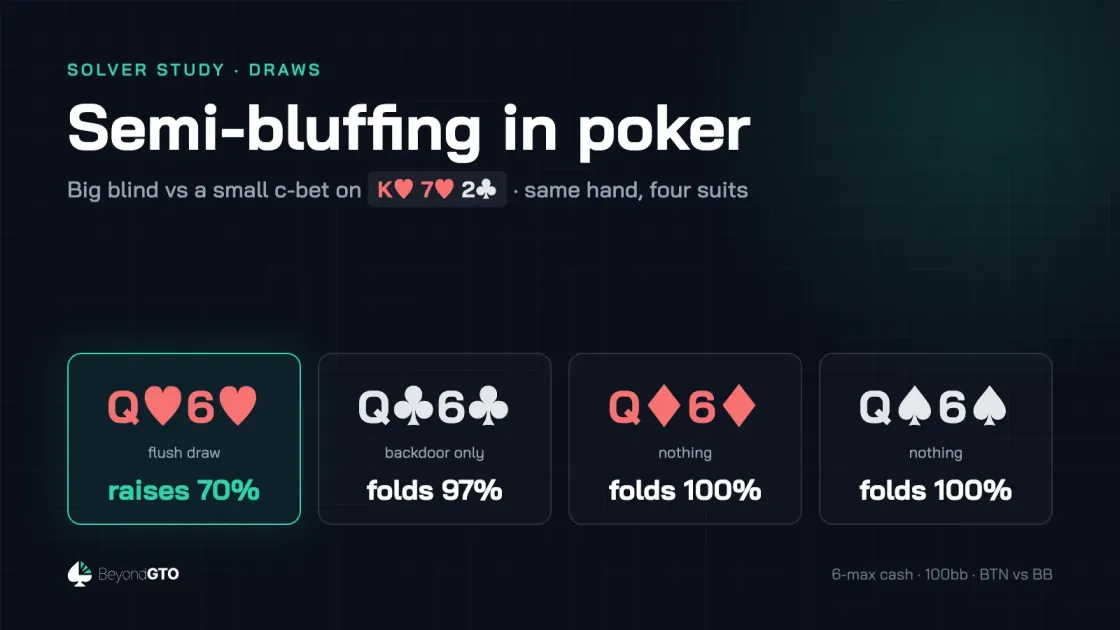
Big blind defends against a button open, the flop is K♥ 7♥ 2♣, and the button c-bets a quarter of the pot. Here is what the big blind does with queen-six suited, according to our solver database, depending only on the suits:
Same ranks, same position, same bet. Three of the four combinations fold almost every time. The one with two hearts doesn’t just continue, it check-raises 70% of the time. Nine cards in the deck turn it into a strong hand, and that is enough to turn a fold into the most aggressive play available.
That is a semi-bluff: a bet or raise with a hand that is probably behind now but can improve to the best hand. Most players know the word. Far fewer know which draws a solver actually raises, which ones it just calls with, and when it gives a draw up. The answers are more specific than “play your draws aggressively”, and some of them run the other way. On this same board the nut flush draw check-raises less often than queen-six of hearts does, and ace-ten of hearts just calls 99% of the time.
This post works through the whole hand with real output: the maths that makes semi-bluffing pay, which draws raise on five different flops, three rules that decide between raising and calling, which draws the button bets, which ones keep firing on the turn, which busted draws bluff the river, and how all of it changes at 20bb in a tournament. Every figure comes from our solver database. The method is at the end.
The short version
- Draws make up the check-raising bluffs, not air. Hands with no pair and no draw check-raise 0–1% on all five flops studied. Every bluff in the big blind’s check-raising range has a draw or at least a backdoor draw.
- More equity, more raising. Combo draws (flush draw plus straight draw) raise most: 65% on Q♠ J♠ T♦, 49% on 9♥ 8♥ 7♠.
- A pair turns a raise into a call. On K♥ 7♥ 2♣, Q♥ 6♥ raises 70% but Q♥ 2♥, with bottom pair added, raises 8%.
- Blockers pick which open-ender raises. On 9♥ 8♥ 7♠, A♥ 6♠ raises 98%; A♠ 6♣, the same straight draw without the heart, raises 0%.
- The best draw is not always the best raise. Ace-high flush draws with a big kicker mostly call. They have enough value to call, so they don’t need folds.
- On the turn, barrel the draws that leave the folds in their range. On 9♥ 8♥ 7♠ 2♣ the button bets open-enders 61% and combo draws 95%, but flush draws only 30%. Its hearts remove the big blind’s heart draws, and those are the hands that fold.
- On the river, bluff the busted draws that can’t win at showdown. Queen-high missed straight draws shove 99%; ace-high ones check 98%.
- Short stacks change what gets raised. At 20bb on 9♥ 8♥ 7♠, a plain flush draw calls 98% of the time; at 40bb it raises 58%.
What a semi-bluff is, and why it needs fewer folds
A pure bluff wins one way: the opponent folds. A semi-bluff wins two ways: the opponent folds, or the opponent calls and you hit. The second way is why draws are the first hands a solver bluffs with, and why it bluffs with them more often than with anything else.
The arithmetic is short. Bet B into a pot of P. If the opponent folds you win P. If they call, the pot becomes P + 2B and you win your equity E of it, having put in B. Setting the expected value to zero gives the share of folds the semi-bluff needs to break even:
folds needed = (B − E(P + 2B)) / (P + B − E(P + 2B))
With E = 0 this is the familiar pure-bluff number, B / (P + B). Every point of equity lowers it. Here it is for four cases: a bet where the draw sees only the next card, and a shove where it sees both:
| Hand | Half pot, one card | Pot, one card | Pot, all-in (two cards) | 2× pot, all-in (two cards) |
|---|---|---|---|---|
| Pure bluff | 33% | 50% | 50% | 67% |
| Gutshot | 25% | 43% | 34% | 54% |
| Open-ender | 14% | 33% | 5% | 30% |
| Flush draw | 10% | 30% | 0% | 20% |
| Flush draw + gutshot | 0% | 19% | 0% | 0% |
| Flush draw + open-ender | 0% | 4% | 0% | 0% |
A pot-size bluff with nothing needs a fold 50% of the time. The same bet with a flush draw needs 30% if the draw only gets to see the turn, and none at all if the bet gets the money in so it sees both cards: 35% equity is more than the 33% the pot is offering. A combo draw needs 4% even with one card to come. At twice the pot, all-in, a flush draw still needs only 20% folds, against 67% for a pure bluff. The gap between the “one card” and “all-in” columns is the reason stack depth matters so much to semi-bluffing, as the tournament section shows.
Even the one-card column flatters draws in two ways. First, it treats a call as the end of the betting. In practice the opponent can bet again on the turn, and a draw that misses then has to fold or pay a second time. Second, it assumes your outs are clean. A low flush draw that hits can still lose to a higher flush, and an open-ender on a two-tone board can make its straight on a card that also completes the flush. A solver prices both effects. That is why the raising frequencies below are lower than the table alone would suggest, and why the turn and river behave so differently from the flop.
For the underlying ideas, see fold equity and implied and reverse implied odds. The semi-bluff glossary entry has the one-line definition.
How much equity is a draw?
The input to that formula is equity, and on the flop equity mostly comes from outs. With 47 unseen cards, the chance of hitting on the next card is outs / 47, and the chance by the river is one minus the chance of missing twice:
| Draw | Outs | Turn only | Turn or river | Rule of 4 / 2 |
|---|---|---|---|---|
| Gutshot | 4 | 8.5% | 16.5% | 16% / 8% |
| Two overcards | 6 | 12.8% | 24.1% | 24% / 12% |
| Open-ender | 8 | 17.0% | 31.5% | 32% / 16% |
| Flush draw | 9 | 19.1% | 35.0% | 36% / 18% |
| Flush draw + gutshot | 12 | 25.5% | 45.0% | 48% / 24% |
| Flush draw + overcard | 12 | 25.5% | 45.0% | 48% / 24% |
| Flush draw + open-ender | 15 | 31.9% | 54.1% | 60% / 30% |
The rule of 4 and 2 is close for single draws and overstates big combo draws (60% against a true 54.1%). The outs calculator does the exact numbers, and the equity cheat sheet has the common matchups. Two caveats apply to every row. Outs are only outs if they give you the best hand, so a flush draw with a low card on a board where the opponent holds higher flush draws is worth less than nine. And these are percentages against a single made hand. Against a range, some of your outs are already dead and some of your non-outs win anyway.
Same hand, four suits
The quickest way to see what a draw is worth is to hold everything else fixed and change only the suits. Here are two hands in the big blind facing the button’s 1.4bb c-bet (a quarter of the pot) on K♥ 7♥ 2♣, 100bb deep:
| Hand | What it has | Fold / call / raise | Fold | Call | Raise |
|---|---|---|---|---|---|
| Q♥ 6♥ | flush draw | 0% | 30% | 70% | |
| Q♣ 6♣ | backdoor flush draw only | 97% | 2% | 1% | |
| Q♦ 6♦ | nothing | 100% | 0% | 0% | |
| Q♠ 6♠ | nothing | 100% | 0% | 0% | |
| 6♥ 5♥ | flush draw | 0% | 67% | 33% | |
| 6♣ 5♣ | backdoor flush draw only | 4% | 73% | 23% | |
| 6♦ 5♦ | nothing | 99% | 0% | 1% | |
| 6♠ 5♠ | nothing | 99% | 0% | 1% |
Fold Call Raise
Queen-six is a fold without hearts and a raise with them. Six-five shows the in-between case. With nothing it folds 99%. With a backdoor flush draw in clubs (two clubs in hand, one on the board) it calls 73% and raises 23%. Six-five also has a backdoor straight draw, and the backdoor flush on top of it is enough to keep the hand in. With the flush draw it never folds.
The same thing happens from the button’s side. On this board the button c-bets 85% of the time, nearly its whole range, yet the flush draw still shows up: Q♥ J♥ bets 90% against 52% for Q♦ J♦, and A♥ 5♥ bets 96% against 52% for A♦ 5♦. Card-level splits like these only show up in solver output read hand by hand, which is why we read them that way for this post.
Practise draws against a c-bet
The trainer deals you hands on flops like these, you pick fold, call or raise and the size, and it grades every decision against the solver. 25 graded hands a day are free, no card.
Which draws check-raise: five flops
Now the whole range. The table shows how often the big blind check-raises against the button’s 1.4bb c-bet on five flops, overall and by type of hand. Hand types are mutually exclusive: “flush draw” means a flush draw with no pair and no straight draw, “combo draw” is a flush draw plus a straight draw, and “air” is no pair, no draw and no backdoor flush draw. A dash means the big blind has almost none of that hand type on that flop.
| Flop | All hands | Air | Gutshot | Oesd | Fd | Nut fd | Combo draw | Top pair | 2 pair+ |
|---|---|---|---|---|---|---|---|---|---|
| K♥ 7♥ 2♣ | 16% | 0% | – | – | 53% | 22% | – | 13% | 95% |
| A♦ K♦ 4♠ | 10% | 0% | 18% | – | 18% | 29% | 63% | 7% | 68% |
| Q♠ J♠ T♦ | 15% | 0% | 11% | 21% | 18% | – | 65% | 4% | 39% |
| 9♥ 8♥ 7♠ | 16% | 0% | 14% | 24% | 30% | 39% | 49% | 7% | 34% |
| T♥ 9♥ 8♥ | 10% | 0% | 1% | 14% | 5% | 67% | 26% | 10% | 19% |
Five things stand out.
- Air never check-raises. The bluffs in the big blind’s check-raising range are all draws or backdoor draws. Anything that misses completely just folds to the small bet.
- Combo draws raise the most on the two-tone boards: 65% on Q♠ J♠ T♦, 63% on A♦ K♦ 4♠ and 49% on 9♥ 8♥ 7♠. With 12 to 15 outs they have the most equity of any draw, so raising risks little and every fold is a bonus.
- Gutshots split three ways. On 9♥ 8♥ 7♠ the big blind folds its gutshots 44% of the time, calls 41% and raises 14%. Against a small bet a gutshot is on the edge: it has just about enough equity to continue, so the solver turns some of them into bluff-raises and gives up the worst. Against the 4.4bb bet the same gutshots fold 85% of the time, and on Q♠ J♠ T♦ 98%.
- Monotone boards flip the flush draws. On T♥ 9♥ 8♥, a single heart is already a flush draw, and only the ace of hearts makes it a draw to the nuts. The lone ace of hearts raises 67%; a low single heart raises 5% and folds 100% to the big bet, while the ace of hearts calls it 99%. When the flush draw might not be good, it is a liability.
- Value raises too. Two pair or better raises between 19% and 95% of the time, depending on the board. That is the point of semi-bluffing: the raising range holds sets and two pairs together with draws, so the button can’t fold everything except the nuts.
The check-raise post covers the value side of this range in detail; the check-raise guide is the short version.
Rule 1: a draw with a pair calls
The clearest pattern in the data is what happens when a draw also has a pair. In every comparison below, adding a weak pair (second pair, bottom pair or a pocket pair below the top card) makes the draw less likely to raise:
| Flop | Draw | Raises (no pair) | Raises (with weak pair) |
|---|---|---|---|
| K♥ 7♥ 2♣ | Flush draw | 53% | 19% |
| 9♥ 8♥ 7♠ | Flush draw | 30% | 11% |
| 9♥ 8♥ 7♠ | Open-ender | 24% | 13% |
| Q♠ J♠ T♦ | Open-ender | 21% | 13% |
| Q♠ J♠ T♦ | Gutshot | 11% | 3% |
| T♥ 9♥ 8♥ | Combo draw | 26% | 2% |
On K♥ 7♥ 2♣ it shows up hand by hand. Q♥ 6♥ raises 70%; Q♥ 2♥, the same flush draw with bottom pair, raises 8% and calls 92%. J♥ 3♥ raises 70%; J♥ 2♥ raises 10%.
The reason is showdown value. A semi-bluff raise does best when the hand can’t win without improving, because then the folds it generates are pure profit. A pair can win at showdown against the button’s missed hands. Raising with it folds out exactly the hands it already beats, and gets called by the ones that beat it. Calling keeps the button’s bluffs in, and the hand still has its draw.
At the table: if your draw comes with a pair, calling is the default. If it comes with nothing, the draw is your raise.
Rule 2: blockers pick which open-ender raises
On 9♥ 8♥ 7♠ many hands have an open-ended straight draw, and the solver raises some of them almost always and others almost never. What separates them is a single heart.
| With a heart | Fold / call / raise | Raise | Without | Fold / call / raise | Raise |
|---|---|---|---|---|---|
| A♥ 6♠ | 98% | A♠ 6♣ | 0% | ||
| Q♥ T♠ | 81% | Q♣ T♦ | 31% | ||
| K♥ T♠ | 71% | K♣ T♦ | 5% |
Fold Call Raise
A♥ 6♠ and A♠ 6♣ have the same straight draw, the same ace-high and the same overcard. The only difference is the ace of hearts, and it moves the raise from 0% to 98%.
The heart works as a blocker. When the big blind raises, the button continues with its strong made hands and its flush draws. Facing the bigger check-raise to 6.2bb, the button calls with 98% of its flush draws and 100% of its nut flush draws, while it folds 100% of its air, 67% of its gutshots and 30% of its own open-enders. A heart in the big blind’s hand removes some of the flush draws that would call, and the ace of hearts removes the best ones, so the raise gets more folds. It also gives the hand a backdoor nut flush draw.
The rule is general: when you choose which draws to raise, pick the ones holding cards from the hands that would call you. The blockers post covers the idea in full.
Rule 3: the best draw is not always the best raise
You might expect the nut flush draw to raise most, since it has the most equity and wins the biggest pots. On K♥ 7♥ 2♣ it raises 22% against 53% for the other flush draws. Here are the big blind’s ace-of-hearts flush draws one by one:
| Hand | Fold / call / raise | Call | Raise |
|---|---|---|---|
| A♥ T♥ | 99% | 1% | |
| A♥ 9♥ | 96% | 4% | |
| A♥ 8♥ | 96% | 4% | |
| A♥ 6♥ | 62% | 37% | |
| A♥ 3♥ | 40% | 60% | |
| A♥ 4♥ | 20% | 80% |
Fold Call Raise
Ace-ten, ace-nine and ace-eight of hearts call almost every time. Ace-four and ace-three raise most of the time. The big-kicker hands have so much value from calling that they don’t need folds: they can beat the button’s missed hands with ace-high, they make the nut flush, and when they hit, the button has hands that will pay them off. The small-kicker hands have less showdown value and a backdoor wheel draw, so they become the raises.
This held at every stack depth we checked on this board. In the tournament trees (button opens, big blind defends, antes in) the plain flush draw raised more than the nut flush draw at 20, 40, 60 and 100bb: 59% against 9% at 20bb, 69% against 25% at 40bb, 76% against 18% at 60bb, 65% against 26% at 100bb.
Don’t over-learn it, though. On boards where the draw is less clean, the nut draw is the one that wants to raise. On 9♥ 8♥ 7♠ the nut flush draw raises 39% against 30%, on A♦ K♦ 4♠ 29% against 18%, and on the monotone board the gap is huge. The general rule is the one from the last two sections: raise the draws that need folds, call with the ones that don’t.
The other seat: which draws the button c-bets
Switch seats. The button is in position and chooses between checking, a 1.4bb bet and a 4.4bb bet (80% of the pot). This table shows how often it bets each type of hand:
| Flop | All hands | Air | Backdoor FD only | Gutshot | OESD | FD | Nut FD | Combo draw | Top pair |
|---|---|---|---|---|---|---|---|---|---|
| K♥ 7♥ 2♣ | 85% | 82% | 87% | – | – | 92% | 90% | – | 87% |
| A♦ K♦ 4♠ | 45% | 18% | 54% | 71% | – | 60% | 64% | 60% | 53% |
| Q♠ J♠ T♦ | 81% | 81% | 97% | 87% | 86% | 81% | – | 92% | 68% |
| 9♥ 8♥ 7♠ | 48% | 32% | 69% | 48% | 52% | 64% | 59% | 72% | 47% |
The pattern depends on how often the board lets the button bet. On K♥ 7♥ 2♣ it bets 85% overall, almost always small, and draws barely change anything: air bets 82%, flush draws 92%. When a range bets almost everything, the draw makes little difference.
On 9♥ 8♥ 7♠, where the button checks about half its range, the draws are what it chooses to bet. Air bets 32%, flush draws 64%, combo draws 72%. Air with a backdoor flush draw bets 69%, more than twice as often as air without one. The draws also take the big size: combo draws use the 4.4bb bet 46% of the time. That is the semi-bluff from the betting side. The big bet sets up a bigger pot for when the draw hits, and it charges the big blind’s own draws to see the turn.
Facing a check-raise, the button rarely re-raises its draws. Against the 6.2bb raise on 9♥ 8♥ 7♠ its flush draws call 98% of the time and its combo draws call 85% and re-raise 15%. In position, a draw that has been raised is happy to see the turn cheaply. For the betting side as a whole, see how to bluff in poker and c-bet strategy by board texture.
Run the flop that matters to you
Pick the board, the positions and the sizes, and see every hand’s fold, call and raise frequencies, split by suit like the tables above. 3 solves a day are free, no card.
The turn: barrel draws that leave the folds in their range
The button c-bet, the big blind called, and the turn bricked. Now the semi-bluff has one card left to hit, and the button has to decide which draws keep betting. Here are three turns. The two K♥ 7♥ 2♣ lines follow the small flop c-bet; the 9♥ 8♥ 7♠ line follows the 4.4bb c-bet. Each figure is how often that type of hand bets (any size) after the big blind checks:
| Board | Air | Gutshot | OESD | FD | Nut FD | Combo draw |
|---|---|---|---|---|---|---|
| 9♥ 8♥ 7♠ 2♣ | 3% | 50% | 61% | 30% | 33% | 95% |
| K♥ 7♥ 2♣ 4♠ | 23% | 65% | 85% | 88% | 34% | 99% |
| K♥ 7♥ 2♣ Q♦ | 37% | 54% | 94% | 89% | 86% | 99% |
Three patterns stand out.
Air gives up and draws keep going. On 9♥ 8♥ 7♠ 2♣ the button bets 54% of its range overall, but it checks its air 97% of the time. Its turn bets come from value hands and draws.
Flush draws barrel less than straight draws on 9♥ 8♥ 7♠ 2♣. Open-enders bet 61%, flush draws 30%. The reason is the same blocker logic as before. The big blind called the flop with a lot of heart draws, and facing a big turn bet its flush draws fold 71% of the time and its combo draws fold 50%. Those are the hands a turn bet wants to fold. When the button holds two hearts, there are fewer of them left for the big blind to have. An open-ender with no hearts leaves them all in, so it gets more folds.
On K♥ 7♥ 2♣ 4♠ the plain flush draw barrels and the nut flush draw doesn’t. Flush draws bet 88%, most of it as an overbet (69% at 11.15bb, about 135% of the pot), while the nut flush draw checks 67%. The big blind’s response explains it: facing that overbet it folds 69% of its own non-nut flush draws and calls with 100% of its nut ones. The nut flush draw doesn’t need that fold. Its ace-high wins some showdowns on its own, and checking gives it a free river to make the nuts without risking a check-raise. The plain flush draw has neither, so it bets. On the Q♦ turn, an overcard that is good for the button’s range, both kinds of flush draw bet (89% and 86%).
The price matters on the other side too. Facing an 80%-pot turn bet (11.44bb into 14.3bb), a calling hand needs 30.8% equity, and an open-ender has 17.4% with one card to come. So the big blind folds its plain open-enders 89% of the time to that bet. Implied odds don’t cover a gap that large. If you are chasing an open-ender on the turn against a big bet, you are paying for the solver’s fold. The pot odds calculator runs this for any size, and the double-barrel guide covers the betting side.
The river: bluff the busted draws that can’t win
On the river every draw has either hit or missed. The missed ones are no longer semi-bluffs, just hands with some showdown value or none. Which ones become bluffs comes down to two questions: can this hand win a showdown, and does it block the hands that would call?
First line: 9♥ 8♥ 7♠ 2♣ K♦. The button bet 4.4bb on the flop and 11.44bb on the turn and got called both times. The pot is 37.2bb, and the button can check, bet 13bb or shove 81.7bb. It shoves 40% of the time overall:
| Hand | What it was | Check / bet / shove | Bets or shoves |
|---|---|---|---|
| Q♠ T♠ | missed open-ender, queen-high | 99% | |
| Q♦ T♣ | missed open-ender, queen-high | 99% | |
| J♣ 5♣ | missed open-ender, jack-high | 99% | |
| A♠ 6♦ | missed open-ender, ace-high | 2% | |
| A♥ 5♥ | missed combo draw, ace-high | 1% | |
| A♥ T♥ | missed combo draw, ace-high | 1% | |
| Q♥ J♥ | missed combo draw, queen-high | 2% |
Check Bet Shove
The queen-high and jack-high missed straight draws shove almost every time. The ace-high ones check almost every time, whether they were straight draws or combo draws. Ace-high beats the big blind’s own missed draws, so it has some showdown value worth keeping. Queen-high has close to none, so bluffing is its only way to win. As groups, missed open-enders shove 59%, missed gutshots 54%, and missed combo draws (many of them ace-high) check 89%.
Second line: K♥ 7♥ 2♣ 4♠ 3♣. The button bet small on the flop, overbet the turn and got called both times. The pot is 30.6bb. Every busted heart draw here is queen-high or worse unless it holds the ace, so showdown value doesn’t separate them. Blockers do:
| Busted flush draw | Blocker | Check / bet / shove | Bets or shoves |
|---|---|---|---|
| 8♥ 5♥ | holds a 5 | 100% | |
| J♥ 5♥ | holds a 5 | 100% | |
| Q♥ 5♥ | holds a 5 | 100% | |
| A♥ 6♥ | holds a 6 | 93% | |
| T♥ 6♥ | holds a 6 | 78% | |
| A♥ 8♥ | no 5 or 6 | 26% | |
| Q♥ 9♥ | no 5 or 6 | 1% | |
| Q♥ J♥ | no 5 or 6 | 1% | |
| 9♥ 8♥ | no 5 or 6 | 1% |
Check Bet Shove
On K♥ 7♥ 2♣ 4♠ 3♣, ace-five and six-five both make straights. A busted flush draw holding a 5 or a 6 removes some of the big blind’s straights, and straights always call. Those hands bluff: 8♥ 5♥, J♥ 5♥ and Q♥ 5♥ shove every time. The ones without a 5 or 6 check at least 98% of the time, and A♥ 8♥ keeps its ace-high and checks 74%. Same draw, same miss, and the river decision comes down to one card.
Put the two lines together and you get the river rule for busted draws: bluff with the misses that have the least showdown value, and among those, the ones that block the opponent’s calls.
Stack depth: the tournament version
Everything so far is 100bb. In tournaments the stacks are often shorter, and that changes the semi-bluff. With less money behind, a raise commits more of your stack, and the opponent can shove over it. The table shows how often the big blind check-raises a small c-bet in our tournament trees (button opens, big blind defends, antes in; c-bet of about 30% pot) at four depths, with the 100bb cash tree for comparison:
| Stacks | FD on K-7-2 | Nut FD on K-7-2 | FD on 9-8-7 | OESD on 9-8-7 | Combo on 9-8-7 |
|---|---|---|---|---|---|
| 20bb MTT | 59% | 9% | 2% | 16% | 57% |
| 40bb MTT | 69% | 25% | 58% | 29% | 46% |
| 60bb MTT | 76% | 18% | 45% | 26% | 43% |
| 100bb MTT | 65% | 26% | 42% | 27% | 52% |
| 100bb cash | 53% | 22% | 30% | 24% | 49% |
The 20bb row stands out on 9♥ 8♥ 7♠. At 40bb and deeper, a plain flush draw check-raises around half the time. At 20bb it raises 2% and calls 98%. A check-raise to 4.7bb there puts about a quarter of the stack in. The button answers it by shoving 19% of the time and folds only 27%. A 35% draw that raises and then faces a shove has turned a cheap call into a coin flip at best. The combo draw still raises (57%), because with 15 outs it is happy to get the money in.
On K♥ 7♥ 2♣ the flush draw keeps raising at 20bb (59%). The button folds a little more often to the raise there (32% against 27%), and on a dry king-high board the flush draw is the big blind’s main way to apply pressure. One more 20bb change: top pair on K♥ 7♥ 2♣ check-raises far more (73% at 20bb against 26% in the 100bb tournament tree), because with that little behind, value hands want to get the money in before a scare card arrives.
The short-stack lesson: at 25bb and below, raise the draws that are happy to get it all in (combo draws, nut draws, draws with overcards) and call with the plain ones on boards that favour the bettor. The SPR post explains why commitment changes the maths, and the 20bb button opening range is the preflop range these trees start from.
How to play your draws: a checklist
- Price it. Count clean outs and convert them with the table above. Against a small bet almost any draw continues; against a big turn bet, a single draw needs implied odds it rarely has.
- Ask whether it has showdown value. A pair or a strong ace-high pushes you toward calling. No showdown value pushes you toward raising (or folding, for weak draws).
- Check your blockers. Holding a card from the opponent’s strongest continuing hands (the nut flush card, the straight card) makes a raise better. Holding cards from the hands that would fold makes it worse.
- Size for the plan. Big bets and raises suit draws that want a bigger pot when they hit and are happy to get the money in. Small bets suit ranges that bet nearly everything.
- Look at the stacks. If a raise commits you, only raise draws you are happy to get all-in with.
- Re-decide every street. On the turn, keep betting draws that still have equity and leave the folds in the opponent’s range. On the river, bluff the misses with the least showdown value and the best blockers, and check the rest.
Five common semi-bluffing mistakes
- Raising every flush draw. The solver raises about half of them on a dry board and far fewer on wet ones. Raising all of them makes your raises easy to read and wastes the draws that wanted to call.
- Raising draws that have a pair. Showdown value is a reason to call. Raising folds out the hands you beat.
- Treating the nut draw as an automatic raise. Ace-big flush draws often do best as calls. Ace-small ones do the raising.
- Calling big turn bets with open-enders. 17% equity against a 31% price is a fold unless the stacks behind are very deep and the opponent pays off.
- Bluffing the river with ace-high. Missed draws with an ace usually check. The missed draws with the worst high cards are the ones that bluff.
Frequently asked questions
- What is a semi-bluff in poker?
- A bet or raise with a hand that is probably behind but can improve to the best hand, usually a flush draw or a straight draw. It wins when the opponent folds and also when it gets called and hits, so it needs fewer folds than a pure bluff. A pot-size bet with a flush draw that sees one more card needs about 30% folds instead of 50%.
- Should you always play draws aggressively?
- No. Draws make up almost all of a solver’s bluffs, but most draws call more often than they raise. In the big blind against a small c-bet, plain flush draws raised between 18% and 53% of the time across the four two-tone flops in this post. Draws with no showdown value and good blockers do the raising; draws with a pair or a strong ace mostly call.
- Is it better to check-raise or call a flush draw?
- It depends on the rest of the hand. Raise more with flush draws that have no pair, a weak kicker, a straight draw or a useful blocker. Call more with flush draws that have a pair or a big ace. On K♥ 7♥ 2♣, Q♥ 6♥ raised 70% while A♥ T♥ called 99%.
- What is a combo draw?
- A hand with a flush draw and a straight draw at once, usually 12 to 15 outs and about 45% to 54% equity with two cards to come. On two-tone flops it is the draw a solver raises most, and at 15 outs it is a favourite against a single pair. With one card to come, a pot-size bet with it needs only 4% folds.
- Should you semi-bluff the turn?
- With the right draws. After a c-bet and a call, the button kept betting combo draws 95% and open-enders 61% on a bricked turn, and checked 97% of its air. Draws that block the opponent’s folding hands (often its own flush draws) bet less.
- How does stack size change semi-bluffing?
- Short stacks make raises commit you. At 20bb in our tournament trees, a plain flush draw on 9♥ 8♥ 7♠ called 98% of the time instead of raising, while combo draws kept raising. Draws you are happy to get all-in with should be your raises when stacks are short.
Go deeper
Four of the flops in this post have full hand-by-hand pages in the spot library: 9-8-7 two-tone, Q-J-T two-tone, A-K-4 two-tone and T-9-8 monotone, and the spot library has the rest. The ranges behind every number are the button opening range and the big blind defence against the button. For the shorter takes on the same topic, see the guide to playing draws aggressively and the check-raise guide. For the matching hand studies, set mining covers the other kind of drawing hand: the small pair that needs to hit.
Find out which of your draws should raise
Drill the spots in this post, or solve your own flop and read the result card by card. 25 graded hands and 3 solves a day are free, no card.
Method: all figures were read from solver output in our solver database on 8 November 2026. Cash figures: 6-max, 100bb effective; the button opens 2.5bb, the big blind calls, 5.5bb pot, big blind checks, button may check or bet 1.38bb or 4.4bb; big blind may check-raise to 3.45bb or 6.21bb against the small bet. Turn and river lines follow the stated flop and turn bets and calls; the big blind checks to the button on each street. Tournament figures: the button-versus-big-blind single-raised-pot trees at 20, 40, 60 and 100bb with antes; the button’s small c-bet is 1.65bb (20bb), 1.83bb (40 and 60bb) and 1.95bb (100bb). Per-hand figures are the solver’s action mix for that exact two-card combination, normalised across actions. The solver reports combination-level frequencies to about one significant figure, so individual combo numbers are accurate to roughly ±5 points. Group figures (flush draws, open-enders and so on) are reconstructed: each combination is classified on the board shown (made hand first, then draws, counted by enumerating the next card), weighted by how often that hand reaches the node (preflop range weight, times the earlier-street action frequencies on turn and river nodes) and averaged. Overall frequencies (“all hands”, “bets 85% overall”) are the solver’s own aggregates. Outs and fold-equity tables are exact arithmetic for a single bet that gets the money in, with clean outs.
Solver data for this topic
Take your game further with GTO and beyond.
Ready to put this into practice?
Drill these spots against the solver, get EV feedback the instant you act, and see exactly where your line diverges from GTO.
Or play five hands in the trainer right now, no account needed →
Level Up Your Poker Strategy
Join thousands of players getting weekly GTO insights, strategy breakdowns, and training tips straight to their inbox. Free forever.
No spam, ever. Unsubscribe anytime.
You're in!
Aleks Nguyen
NL1k+ Reg, GTO Coach
Writes the solver-decoded studies on this site: the flop c-bet, 3-bet and check-raise series, and the facing-a-raise and opening-range pages they draw on. Plays mid-to-high-stakes 6-max cash online and coaches preflop construction and range analysis. His method notes state the exact tree and decode date behind every number.