Is 7-2 offsuit really the worst hand in poker? The numbers say: it depends
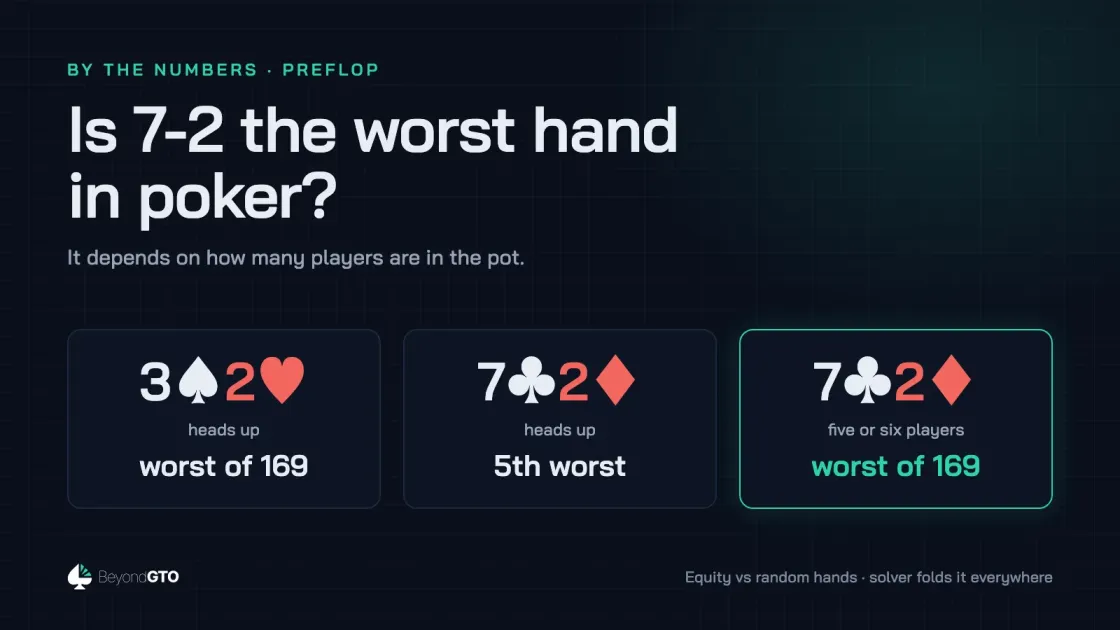
Everyone knows seven-deuce is the worst hand in poker. Heads up, it isn't: four hands are weaker, and 3-2 offsuit is the real bottom. Here is when 7-2 earns its reputation, and what the solver does when you deal it one.
Ask a room full of poker players for the worst starting hand and you will get one answer, loudly, before you finish the question. Seven-deuce offsuit. It has its own house games, its own bounty rule, its own mythology. Nobody has ever been dealt it and felt good about it.
Here is the awkward part: heads up, it is not the worst hand. It is not even second worst. Four hands are weaker, and one of them beats it to the bottom by more than two percentage points. Seven-deuce only takes the crown once the table gets crowded, which, as it happens, is exactly where its reputation was made.
So let us settle it properly, with numbers, and then ask the solver what it would actually do if you dealt it seven-deuce. (Spoiler: it is not a long section.)
Heads up, 7-2 is only the fifth-worst hand
Deal 7-2 offsuit against one random hand, run all five board cards, and it wins 34.6% of the time. That is bad. But 3-2 offsuit wins 32.4%, and 4-2, 6-2 and 5-2 offsuit all sit below seven-deuce as well.
The reason is unglamorous. Heads up, most pots are won by a pair or by plain high card, and a seven is simply a better high card than a three, four, five or six. When neither player pairs, "seven high" beats a surprising number of random hands. 3-2 offsuit has nothing: its best card loses to everything except a 2.
Add players and 7-2 sinks to the bottom
Now deal more people in. The more opponents there are, the less high card matters: someone almost always makes a pair or better, so you need to make a hand to win. And that is where seven-deuce falls apart.
| Players in the hand | 7-2 offsuit | 3-2 offsuit | Weaker of the two | Where 7-2 ranks (1 = worst) |
|---|---|---|---|---|
| 2 | 34.6% | 32.4% | 3-2 | 5 of 169 |
| 3 | 20.6% | 19.8% | 3-2 | 2 of 169 |
| 4 | 14.2% | 13.9% | 3-2 | 2 of 169 |
| 5 | 10.7% | 10.9% | 7-2 | 1 of 169 |
| 6 | 8.6% | 8.9% | 7-2 | 1 of 169 |
With three or four players in the hand, 7-2 is the second-worst hand at the table. With five or six, it is the worst of all 169.
The culprit is the gap. A straight is five cards in a row, so two cards can only both play in a straight if they are at most four ranks apart. Seven and deuce are five apart. 7-2 offsuit can never make a straight that uses both of its cards, and being offsuit, it cannot make a flush with both either. Its cards do not cooperate on any board.
3-2 offsuit is just as weak in raw strength, but its cards work together: A-2-3-4-5 and 2-3-4-5-6 both use the pair of them. In a five-way pot, those few extra ways to make a real hand are enough to drag it off the bottom. (You can check any hand at any table size on our multiway equity table.)
So both camps are right. 3-2 offsuit is the worst hand heads up. 7-2 offsuit is the worst hand at a full, loose table. Seven-deuce got its reputation at home games and old card rooms where five people saw every flop, and there, it really is the bottom of the barrel.
What the solver does with it
We looked up 7-2 offsuit in every preflop chart in our solver database. The full record is on its 7-2 offsuit hand page, but here is the summary:
- 6-max cash, 100bb, first to act: fold, from every seat, including the button and the small blind.
- Tournaments at 10 to 20 big blinds, first to act: fold, from every seat, at every depth in our opening ranges.
- Push or fold at 5 big blinds, folded to you in the small blind: fold. At that stack the solver shoves 137 of the 169 hand types, including K-2, Q-2 and J-2 offsuit. Seven-deuce is one of the 32 it throws away. So is 3-2 offsuit, to be fair.
The most telling spot is the big blind. Facing a 2.5bb button open, the big blind needs to call 1.5bb into a pot that will be 5.5bb, so it only needs about 27% equity to break even on the call. Seven-deuce has 34.6% against a random hand. And the solver still folds it every time.
That is the actual lesson hiding in the joke. Equity against a random hand is not equity against a range: the button is not opening random hands, and a hand that can barely make a pair or a straight cannot turn the equity it does have into chips once the betting starts. Seven-deuce does not just lose often. It loses expensively, because when it makes something, it is usually second best.
The one place 7-2 is a good hand
Home games fixed the problem the only way they could: by bribing people to play it. In the "7-2 game", anyone who wins a pot holding seven-deuce (and shows it) collects a bounty from everyone else at the table. Suddenly the worst hand in poker is the most exciting one to look down at.
No solver models that rule, and you should not need one to see why it works. If five opponents each owe you a bounty when you win with 7-2, every pot you take down with it is worth five bounties more than the chips in the middle. Opening it on the button and taking the blinds with one bet is now a profitable bluff even when the cards say otherwise. Just know that everyone at the table can do the same arithmetic, and the moment you raise, they start wondering.
If you want a different bit of trivia for the table: the last hand of Doyle Brunson's 1976 World Series Main Event win was ten-deuce, and so was the last hand of his win in 1977. That is why T-2 is still called "a Doyle Brunson". He won both, which says a lot about poker and nothing good about ten-deuce.
The takeaway
- Heads up, 3-2 offsuit is the worst hand. 7-2 offsuit is the fifth-worst.
- In a pot with five or more players, 7-2 offsuit is the worst hand. Its cards can never combine for a straight, and that matters when you need to make a hand to win.
- The solver folds it everywhere, even from the small blind at 5 big blinds and even in the big blind with a good price.
- Equity against a random hand is a trap. What counts is equity against the range you are facing, and how much of it you can actually win.
Knowing which hands to throw away is half of preflop poker, and the half that saves the most money. If you want to see how fast you can spot the folds, play five hands in the trainer, no account needed. Our guide to what hands to play by position covers the other half, and if your home game really does see five players to every flop, here is how to beat a table that never folds.
Drill 6-max opening ranges (25 graded hands a day, free)
Method: equities are Monte Carlo simulations (250,000 trials per hand and table size) against uniformly random opponent hands, with all five board cards dealt and no folding, from our multiway equity table. Preflop decisions come from our solver database: 6-max cash at 100bb (opens to 2.5bb, 3bb from the small blind), and chip-EV tournament first-in charts at 5 to 20 big blinds, with push-or-fold trees at 15bb and below. "Players in the hand" counts you as one of them.
New to poker? Start here
Solver data for this topic
Take your game further with GTO and beyond.
Ready to put this into practice?
Drill these spots against the solver, get EV feedback the instant you act, and see exactly where your line diverges from GTO.
Or play five hands in the trainer right now, no account needed →
Level Up Your Poker Strategy
Join thousands of players getting weekly GTO insights, strategy breakdowns, and training tips straight to their inbox. Free forever.
No spam, ever. Unsubscribe anytime.
You're in!
Lena Varga
MTT Pro, Poker Mom
Writes the tournament side of the site: ICM and pay-jump dynamics, push/fold ranges by stack and position, final-table play, and the same-day solver reviews of livestreamed hands. A decade of mid-stakes MTT results, most of it online.